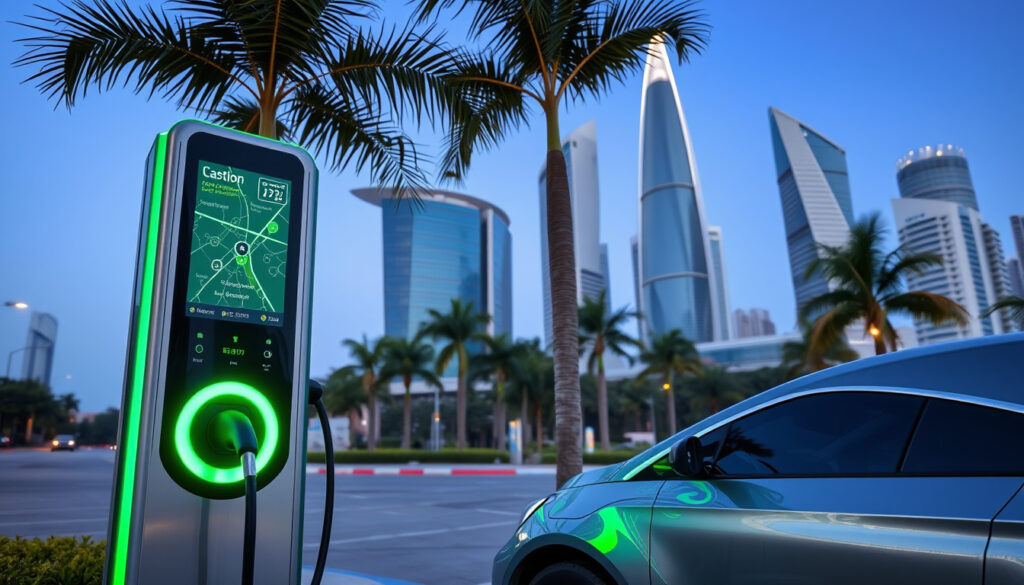
EV Charging Stations Singapore: Map, Costs, Free Spots
Singapore’s EV charging network has expanded faster than most drivers expected. The Land Transport Authority reports more than 7,100 publicly accessible charging points island-wide, with the Green Plan 2030 targeting 60,000 chargers by decade’s end. If you’ve been wondering where to charge, what it costs, and whether going electric actually saves money here, this guide lays out the numbers from official sources and trusted maps.
Total EV charging stations: 1,163 · Free charging locations: 47 · Top mapping apps: PlugShare, Electromaps · Key providers: Charge+, TotalEnergies · Government guide source: Land Transport Authority (LTA)
Quick snapshot
- 1,163 stations via Electromaps (Electromaps)
- Public charging: S$0.50–S$0.80/kWh (The Business Times)
- Every HDB town EV-ready by end-2025 (Land Transport Authority)
- Exact costs vary by operator beyond the S$0.50–S$0.80 range
- Post-April 2026 price updates not yet published
- Real-time charger occupancy data limited across most networks
- All HDB towns EV-ready by 2025 (LTA)
- Green Plan 2030 aims for 60,000 chargers (Fomo Energy)
- April 2026 electricity tariff hike may raise rates (The Business Times)
- Charging prices expected to rise after April 2026 tariff adjustment
- Network expansion accelerating toward Green Plan targets
- More DC fast chargers arriving at HDB carparks
| Metric | Value | Source |
|---|---|---|
| Total stations | 1,163 (Electromaps) | Electromaps |
| Free spots | 47 locations | LTA |
| Mapping tools | PlugShare, ChargeWhere.SG | ChargeWhere.SG |
| Official guide | LTA Electric Vehicle Guide | Land Transport Authority |
Where to charge EV for free in Singapore?
Free public charging is rare in Singapore. Most locations charge per kilowatt-hour, but community maps have identified 47 spots where drivers can plug in at no cost. These typically come bundled with shopping centre promotions or limited-time operator campaigns rather than standing public infrastructure.
Free EV Charging at 47 Locations
PlugShare’s community-verified map tracks free charging locations across Singapore, though availability shifts with promotional calendars. A January 2025 update added the Jalan Sultan charging point to Electromaps, illustrating how quickly these listings change. Drivers relying on free spots should check community maps frequently for the latest availability.
Free charging locations tend to disappear once promotional periods end. Treat them as bonuses rather than a primary charging strategy — relying on them invites frustration when they vanish without notice.
How much does EV charging cost in Singapore?
Public charging rates in Singapore sit between S$0.50 and S$0.80 per kWh as of early 2026, according to The Business Times. This pricing has remained relatively stable, though an electricity tariff increase expected in April 2026 may push rates upward.
Pricing from providers like Charge+
Charge+ operates one of Singapore’s larger networks, offering Pay As You Go billing through its app. TotalEnergies similarly provides PAYG options for locating the nearest available point. SP Mobility calculates fees on a straightforward per-kWh basis: electricity consumed multiplied by the applicable rate per kWh.
For home charging, Singapore’s average residential electricity rate runs approximately $0.30 per kWh, making a full 50 kWh charge cost roughly $15 at home versus $25–$40 at public fast chargers. Home charger installation, however, runs $1,000 to $4,000 — a significant upfront investment not permitted in public HDB lots.
Cheapest EV charging stations Singapore
The most cost-effective approach combines home charging for routine needs with public charging only during longer trips. Bluecharge offers 1,500 AC points with hourly rates that can work cheaper than per-kWh pricing for vehicles parked several hours, such as at workplaces.
April 2026 electricity tariff increases will likely raise both home and public charging costs. Senior managers at major charging operators told The Business Times that absorbing small increases is possible, but large ones would force rate revisions upward.
Which is the best EV charging operator in Singapore?
No single operator dominates every neighbourhood, but Charge+ and TotalEnergies lead in network coverage and app usability. The “best” depends on your location, vehicle connector type, and whether you prefer per-kWh or hourly billing.
Top operators: Charge+, TotalEnergies
ChargeWhere.SG aggregates over 400 EV charging stations across 9 operators, giving drivers a single view of availability regardless of which network operates a specific point. This aggregator approach often outperforms relying on any single operator’s app, especially in areas where coverage overlaps.
| Operator | Key feature | Billing model | Source |
|---|---|---|---|
| Charge+ | Largest network coverage | Per kWh, PAYG app | SP Mobility |
| TotalEnergies | PAYG app for nearest points | Per kWh | TotalEnergies |
| Bluecharge | 1,500 AC points | Hourly for long-stay parking | Fomo Energy |
| SP Mobility | SP Utilities app integration | Per kWh | SP Mobility |
The implication: network diversity actually benefits drivers. Having multiple operators means more physical points, but it also means navigating several apps. Aggregators like ChargeWhere.SG solve this friction by consolidating availability data.
How to use public EV chargers in Singapore?
Using public chargers requires an app, a compatible cable, and an understanding of your vehicle’s inlet type. Singapore’s public chargers use Type 2 and Combo 2 connectors universally, covering virtually all EVs sold in the market.
Steps via apps like ChargeWhere.SG
The process follows four steps: locate an available charger via your chosen app, verify the connector type matches your vehicle, initiate the session through the operator’s app or RFID card, and monitor progress until your target state of charge. For slower AC chargers rated 7.4–22 kW, expect 6–10 hours for a full charge — best suited for overnight parking. DC fast chargers rated 50–120 kW and above deliver 20–45 minute quick top-ups for drivers in a hurry.
AC overnight charging costs roughly half what DC fast charging costs for the same session, but requires your vehicle to sit for hours. Drivers who cannot leave their car parked overnight at a charger with public access should prioritise locations with DC fast capability — even at higher per-kWh rates, the time saved often justifies the premium.
EV charging stations Singapore app
Four apps cover most needs: MyTransport.SG (LTA’s official app), Electromaps (iOS/Android with 1,163 Singapore stations), the SP Utilities app for SP Mobility locations, and PlugShare for its global database of over 440,000 stations. Proton e.MAS recommends PlugShare for public stations in car parks and malls, where the majority of Singapore’s charging infrastructure is concentrated.
Is EV cheaper than petrol in Singapore?
The answer depends on how you calculate ownership: upfront costs, fuel, maintenance, and certificate of entitlement (COE) premiums all factor in. VINCAR EV’s cost analysis suggests that when comparing fuel alone, electric vehicles do carry a meaningful per-kilometre advantage over petrol equivalents — but the math closes quickly once COE and vehicle pricing enter the equation.
Cost breakdowns versus petrol
A petrol car consuming 8L/100km at S$2.50 per litre costs roughly S$0.20 per kilometre for fuel alone. A comparable EV charging at S$0.60 per kWh with 15 kWh per 100km efficiency costs S$0.09 per kilometre in electricity — less than half the fuel cost. However, Singapore’s EV prices remain elevated due to import duties and COE premiums, partially offsetting this operational saving.
Upsides
- Electricity costs per km roughly 50–60% lower than petrol equivalent
- Reduced maintenance (no oil changes, fewer brake wear items)
- Every HDB town EV-ready by 2025 means charging access improving
- Green Plan 2030 target of 60,000 chargers signals long-term infrastructure commitment
Downsides
- Higher upfront vehicle cost offsetting fuel savings
- Home charger installation $1,000–$4,000 not permitted in HDB public lots
- Free charging rare; operational costs unavoidable for most drivers
- April 2026 tariff hike may narrow the fuel cost advantage
EV Chargers in Singapore: Types and Specifications
Singapore’s public charging infrastructure supports two connector standards across all stations: Type 2 for AC charging and Combo 2 (CCS2) for DC fast charging, per LTA specifications. Every public charger deployed under the EV charging framework must support these standards, ensuring compatibility across brands.
| Charger type | Power | Charge time (50 kWh battery) | Typical use |
|---|---|---|---|
| AC Slow | 7.4 kW | 6–8 hours | Overnight home/carpark |
| AC Medium | 11–22 kW | 3–6 hours | Workplace, malls |
| DC Fast | 50–120 kW+ | 20–45 minutes (to 80%) | Highway, quick top-up |
The pattern: AC infrastructure dominates because it costs less to install and suits Singapore’s predominantly urban parking patterns. DC fast chargers serve a different need — quick returns — and remain concentrated in fewer locations.
Step-by-Step: How to Start Charging Your EV
New EV owners often ask the same question SP Mobility receives regularly: how do I actually start charging? The process differs slightly by operator but follows a consistent sequence.
- Find a station — Use PlugShare, Electromaps, or ChargeWhere.SG to locate a compatible charger near you. Filter by connector type (Type 2 or CCS2) and availability.
- Verify connector compatibility — Check that your vehicle’s inlet matches the charger’s output. Singapore’s standard is Type 2 for AC and Combo 2 for DC.
- Initiate the session — Open the operator’s app (Charge+, TotalEnergies, SP Mobility) or tap your registered RFID card at the charger. Some locations require advance reservation through the app.
- Connect the cable — Plug the cable into your vehicle inlet first, then into the charger. Wait for the confirmation light before stepping away.
- Monitor progress — Track state of charge through the app. SP Mobility calculates fees on a per-kWh basis: electricity consumed multiplied by the applicable rate.
- End the session — Stop charging via app or card, then disconnect in reverse order. Unplug from vehicle last to avoid any safety lockout.
“We are watching energy prices closely, and it is quite clear that the electricity tariff is likely to increase – the question is how much.”
— Senior manager at major charging point operator, The Business Times
“We have more than 7,100 publicly accessible charging points island wide.”
— Land Transport Authority, Land Transport Authority (EV Guide for Drivers)
Singapore’s EV charging landscape presents a clear trade-off: operational costs run lower than petrol equivalents, but the infrastructure for truly frictionless charging still requires navigating multiple apps and understanding rate structures before you plug in. The network is expanding rapidly — by the end of 2025, every HDB town will have chargers at nearly 2,000 carparks — yet free charging remains the exception rather than the rule.
For Singapore drivers, the electricity tariff hike looming in April 2026 is the variable most worth watching. If rates climb significantly, the per-kilometre cost advantage of EVs over petrol narrows — and the case for going electric shifts from clear win to marginal benefit depending on your driving pattern and access to home charging.
For drivers weighing whether to make the switch, the calculus is concrete: public charging costs roughly S$0.60 per kWh at most stations today, home charging runs about S$0.30 per kWh, and petrol equivalents consume S$0.20 per kilometre. EVs win on fuel, but the home charger installation cost ($1,000–$4,000) and higher vehicle purchase price mean you need consistent daily driving or workplace charging access to recoup the premium within a reasonable ownership window.
Related reading: cheapest SIM-only plans in Singapore · houses for rent in Singapore
bydcars.sg, kia.com, spmobility.sg, vincarev.com, tysenkld.com.sg
Frequently asked questions
How long does it take to charge an EV in Singapore?
AC slow chargers (7.4–22 kW) take 6–10 hours for a full charge — best for overnight parking. DC fast chargers (50–120 kW+) deliver 20–45 minutes for an 80% top-up, making them suitable for quick stops during longer journeys.
What is the 80% rule for EV charging?
Many public chargers cap charging at 80% to reduce heat buildup and shorten wait times for other drivers. Most EVs allow you to adjust the target state of charge in the vehicle’s settings to align with this limit.
How many EV charging stations are in Singapore?
Electromaps lists 1,163 charging stations across Singapore, while the LTA reports more than 7,100 publicly accessible charging points island-wide — the difference reflects how charging points (individual connectors) versus stations (physical locations with multiple points) are counted.
How do I find EV charging stations near me?
The most reliable apps for Singapore are PlugShare (community-verified), Electromaps (1,163 stations with real-time data), ChargeWhere.SG (aggregates 400+ stations from 9 operators), and MyTransport.SG (LTA’s official channel). Filter by connector type and availability before heading out.
Is there free EV charging in Singapore?
Free public charging is rare, with community maps identifying approximately 47 locations where free charging is available — typically tied to promotional campaigns at shopping centres or temporary operator offers. Most drivers will pay S$0.50–S$0.80 per kWh at standard public chargers.
What connector types do Singapore EV chargers use?
All public EV chargers in Singapore support Type 2 (AC) and Combo 2 (CCS2, DC fast charging) connectors, per LTA specifications. These cover every EV currently sold in the Singapore market.
More related posts
 When I Was Four Singapore: Store Location & Opening Hours
 Xiaomi 15 Ultra Price in Ireland: Deals from €1,499
 CapitaLand REIT Share Price: Is It a Good Buy? (2026)
 Shanghai Weather in May: Temps, Rain & What to Pack 2026
 Birthday Gifts for Her: Best Ireland Ideas & Rules
 Hong Kong Airport Spotted: Best Plane Spotting Locations
 Indian Super League Games – Live Scores, Fixtures and Standings
 Xiaomi Service Center Singapore: Locations, Warranty & Repairs