What Is a Root Canal? Procedure, Pain, Cost in UK & Recovery
If you’ve been told you need a root canal, the phrase alone might be enough to make your jaw clench — but the reality is far less frightening than the reputation suggests. This procedure has been perfected over decades to save natural teeth that would otherwise need extraction, and for most patients, the experience is closer to getting a filling than enduring something dramatic. Understanding what actually happens, what it costs in the UK, and what recovery looks like can take a lot of the anxiety out of that dental chair.
Typical Cost in UK: £600-1,400 ·
Average Duration: 60-90 minutes ·
Success Rate: 95% ·
Crown Needed After: Most cases ·
Pain Level (1-10): 2-4 with anesthesia
Quick snapshot
- Removes inflamed or infected pulp (Emergency Dentist in London)
- Cleans and disinfects inside tooth (Emergency Dentist in London)
- Local anaesthesia makes procedure painless (Emergency Dentist in London)
- Post-treatment soreness manageable with OTC painkillers (Cunning Dental)
- Private treatment ranges £600-1,400 total (Emergency Dentist in London)
- Preserves natural tooth vs. extraction (Emergency Dentist in London)
- Most cases require a crown afterward (Cunning Dental)
- Tooth feels normal within a week (Cunning Dental)
The table below summarises the core clinical parameters for root canal treatment in the UK.
| Factor | Details |
|---|---|
| What it treats | Infected tooth pulp |
| Duration | 1-2 visits |
| Success rate | 95% |
| UK cost range | £600-1,400 |
What is actually done in a root canal?
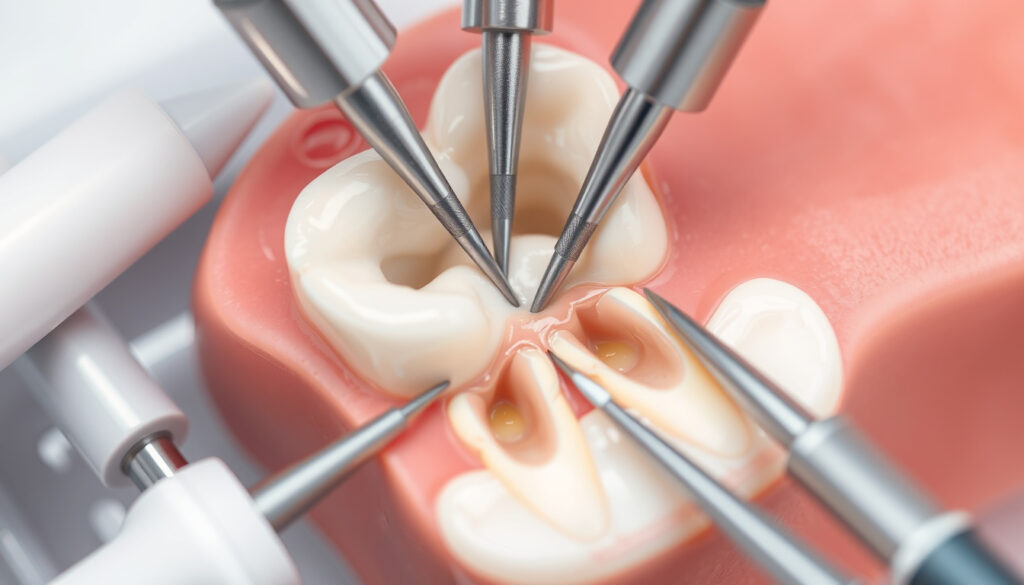
A root canal treats infection or inflammation inside the tooth where the nerve and pulp reside. When decay or trauma reaches this inner chamber, the tooth becomes painful and risks losing the entire structure — unless intervention happens.
Removing infected pulp
The dentist creates a small opening in the tooth crown and uses fine instruments to extract the inflamed or infected pulp tissue entirely. This step eliminates the source of pain and prevents bacteria from spreading further into the jawbone.
Cleaning and disinfecting canals
Once the pulp is removed, the dentist cleans and shapes each canal within the root using antiseptic solutions. This disinfecting phase is critical — any remaining bacteria could compromise the seal and allow reinfection.
Filling and sealing
The cleaned canals are filled with a rubber-like material called gutta-percha, then sealed with adhesive cement. A temporary filling closes the access hole until a permanent crown is placed, protecting the now-hollow tooth from fracture.
The implication: saving your natural tooth through this three-step process avoids the cost and complexity of implants or bridges down the line.
How painful is a root canal?
The myth of extreme pain has persisted for decades, but modern dentistry has thoroughly debunked it. Root canal treatment is designed to alleviate pain, not cause it, and local anaesthesia ensures the procedure feels equivalent to a routine filling.
During the procedure
With the area numbed completely, patients feel pressure but no sharp pain during the procedure. The discomfort people associate with root canals actually comes from the infection itself before treatment begins, not from the dental work.
Pain scale 1-10
Most patients rate the procedure at 2-4 on a 10-point scale once anaesthetised. That’s a significant relief compared to the severe toothache that precedes the diagnosis.
Post-treatment discomfort
After the anaesthesia wears off, mild soreness is normal for one to two days. This bruising sensation is manageable with over-the-counter painkillers like paracetamol or ibuprofen and is considerably less disruptive than recovery from tooth extraction.
Patients in the UK often delay treatment due to fear of pain, but waiting only allows infection to worsen. Root canal relieves the source of agony, not creates new discomfort.
The pattern: the anxiety before the procedure is almost always worse than the actual experience, and most patients return to normal activities within 24-72 hours.
How long does a root canal take?
Most root canal treatments in the UK are completed in a single appointment lasting 60-90 minutes. Complex cases involving molars with multiple canals may require two visits spread over a week or two.
Single visit vs multiple
Front teeth and premolars with single canals typically finish in one session. Molars with two or three canals need more time for thorough cleaning, which is why your dentist may schedule a follow-up appointment for completion and temporary dressing between sessions.
Factors affecting time
The severity of infection, tooth position, and number of canals all influence procedure length. Retreatment cases — where a previous root canal has failed — also take longer because the dentist must remove old filling material before re-cleaning.
Recovery timeline
Day one brings slight soreness easily controlled with mild painkillers. By days two and three, sensitivity decreases noticeably. Within a week, the treated tooth feels entirely normal and ready for the permanent crown placement.
Root canal recovery is more straightforward than tooth extraction, with less swelling and a faster return to eating normally within a day or two.
What this means: unlike extractions that can require weeks of gum healing, a root canal gets you back to work or routine within 24-48 hours in the vast majority of cases.
How do you know if you need a root canal?
Recognising the warning signs early can save your tooth and prevent more extensive treatment. Several symptoms indicate that infection has reached the pulp chamber where root canal treatment becomes necessary.
Common symptoms
- Severe tooth pain when chewing or applying pressure
- Prolonged sensitivity to hot or cold temperatures even after the stimulus is removed
- Darkening or discolouration of the affected tooth
- Swelling and tenderness in nearby gums
- A recurring pimple-like bump on the gums (drainage abscess)
Causes
Deep tooth decay that penetrates through enamel and dentin into the pulp chamber is the most common cause. Cracked or chipped teeth and repeated dental work on the same tooth can also allow bacteria entry, eventually necessitating endodontic treatment.
When to see dentist
Any persistent tooth pain lasting more than a day or two warrants professional evaluation. Swelling in the face or jaw accompanied by fever indicates a serious infection requiring urgent dental attention — delaying treatment risks spreading bacteria into the bloodstream.
The catch: ignoring these symptoms won’t make them disappear. Untreated pulp infections can lead to bone loss around the tooth root and ultimately require extraction, which costs more to replace.
How much does a root canal cost in the UK?
Understanding the financial side helps patients plan ahead. Private root canal treatment in the UK ranges from £600 to £1,400 depending on which tooth requires work and whether a specialist endodontist performs the procedure.
Price range
Anterior tooth root canal (front teeth with single canals) typically costs £600-£900. Premolars run £700-£1,000, while molars — with their complex multi-canal systems — range from £1,000-£1,400 privately.
What affects cost
- Tooth location: molars cost more due to canal complexity
- Whether a general dentist or specialist endodontist performs treatment
- Geographic location within the UK
- Whether the case involves retreatment of a previous root canal
Crown additional
The root canal itself is only part of the total cost. Most treated teeth require a crown afterward to prevent fracture of the now-brittle tooth structure. Crowns add £400-£1,200 depending on material (metal, porcelain-fused-to-metal, or all-ceramic).
NHS treatment offers lower costs but limited appointment availability and fewer material choices. Private treatment provides faster scheduling and more crown options, but the £600-£1,400 investment preserves your natural tooth — worth considering against implant costs of £2,000-£4,000+.
What this means: the total investment for a root canal plus crown typically ranges £1,000-£2,600, which is still less expensive than extraction plus implant or bridge replacement over a 10-15 year horizon.
Upsides
- Preserves natural tooth structure
- 95% success rate when performed correctly
- Procedure is painless with modern anaesthesia
- Recovery typically 24-72 hours
- Cheaper long-term than extraction plus implant
- Eliminates source of tooth infection
Downsides
- Crown usually required afterward (extra cost)
- May require multiple appointments for molars
- Tooth can become slightly more brittle over time
- Higher upfront cost than simple filling
- Risk of reinfection if seal fails
- NHS availability limited in some areas
What to expect: step by step
- Diagnosis and X-ray: Your dentist examines the tooth and takes an X-ray to assess infection extent and canal anatomy.
- Anaesthesia: Local anaesthetic numbs the area completely so you feel no pain during the procedure.
- Rubber dam placement: A protective sheet isolates the tooth and keeps it dry from saliva during treatment.
- Pulp removal: The dentist creates a small access hole and removes the infected pulp tissue.
- Canal cleaning: Fine files and antiseptic solutions clean and shape each canal meticulously.
- Filling: Gutta-percha fills each canal, sealed with adhesive cement to prevent reinfection.
- Temporary restoration: A temporary filling closes the tooth until the permanent crown is placed.
- Permanent crown: After 1-2 weeks of healing, the dentist fits a custom crown for long-term protection.
Root canal therapy relieves pain caused by infection or inflammation within the tooth. The discomfort patients experience before treatment is far greater than anything felt during the procedure itself.
— Emergency Dentist in London (dental practice providing emergency endodontic care)
The myth that significant after-pain is normal with root canal is simply false. Most patients experience only mild bruise-like soreness manageable with over-the-counter painkillers.
— Harley Street Dental Clinic (specialist dental practice)
For UK patients facing a root canal decision, the path is clear: modern treatment is virtually painless, recovery is rapid, and preserving your natural tooth costs less in the long run than extraction and replacement options.
Related reading: Symptoms of Kidney Problems · Blood Pressure by Age
richmondva.dentist, harleystreetdentalclinic.co.uk, smiledentist.co.uk, shinedentalclinic.co.uk, memorialdentists.com, whitesdental.co.uk
Frequently asked questions
Are root canals permanent?
Root canal treatment has a 95% success rate, and with proper crown placement and oral hygiene, treated teeth can last a lifetime. The key factors are complete infection removal, a secure seal, and protecting the tooth with a crown to prevent fracture.
What are root canal side effects?
Minor side effects include temporary soreness, slight swelling, or tenderness when biting for a few days after treatment. Serious complications are rare but can include infection recurrence if the seal fails or a cracked root if the tooth isn’t protected with a crown.
How to avoid needing a root canal?
Preventive measures include maintaining excellent oral hygiene, attending regular dental check-ups, treating cavities early before they reach the pulp, wearing a mouthguard during sports to prevent tooth trauma, and avoiding chewing on very hard objects that could crack teeth.
What causes need for a root canal?
The primary causes are untreated dental decay that progresses through enamel and dentin to the pulp, cracked or broken teeth from injury or biting hard objects, and repeated dental procedures on the same tooth that eventually irritate the pulp chamber.
Do you always need a crown after root canal?
In most cases, yes — a crown is recommended to protect the now-brittle tooth from fracture. Front teeth with single canals and minimal remaining structure might get away with just a large filling, but molars almost always require crown coverage for functional durability.
What is root canal recovery like?
Recovery is straightforward: mild soreness for 24-48 hours manageable with paracetamol or ibuprofen, reduced sensitivity by day two or three, and the tooth feeling completely normal within a week. Most UK patients return to normal activities within one to three days.
Is there a new alternative to root canal?
Some practices are exploring advanced irrigation systems like GentleWave that clean canals more thoroughly, but traditional endodontic treatment remains the gold standard. The alternative is extraction followed by implant or bridge, which costs more and requires more invasive procedures overall.
More related posts
 Liverpool vs Man City: VAR Review, How to Watch & Results
 You Are My Hero Review: Worth Watching? Story & Song
 Jung So-min Movies and TV Shows: Full List 2024-2025
 Lifelong Learning Institute Parking: Rates & Directions
 Pasir Ris Central Post Office Guide: Location, Hours & Services
 Cheapest SIM Only Plan Singapore – From $7 With 77GB Data
 Marine Parade Tuition Centre – Top Options Near Parkway Parade
 Rayo Vallecano vs Real Madrid: Prediction, Lineups & H2H