Area of Circle Formula: πr² with Diameter & Examples
If you’ve ever forgotten whether it’s πr² or 2πr, you’re not alone—millions of students revisit this formula every year. The good news is that once you see how radius, diameter, and circumference interconnect, the confusion dissolves. Below, you’ll find the standard circle area formula, step-by-step derivations, and the historical mathematicians who proved it over two millennia ago.
Standard Formula: A = πr² · Pi Value: 3.14159 · Circumference: C = 2πr · Diameter Version: A = π(d/2)² · Relationship: πr² for radius r
Quick snapshot
- The area enclosed by a circle of radius r is πr² (Khan Academy)
- Pi (π) represents the constant ratio of circumference to diameter (Wikipedia)
- No regional or cultural variations documented in formula notation
- Limited coverage of circle formulas in non-Euclidean geometries
- Step-by-step calculation examples
- Derivation from circumference to area
The key measurements and relationships for circle calculations are summarized in the table below.
| Label | Value |
|---|---|
| Core Formula | πr² |
| Pi Definition | Circumference / diameter |
| Diameter Version | π(d/2)² |
| Circumference | 2πr |
| Radius Relation | Half of diameter |
| Derivation Method | ½ × circumference × radius |
What is a formula for area of a circle?
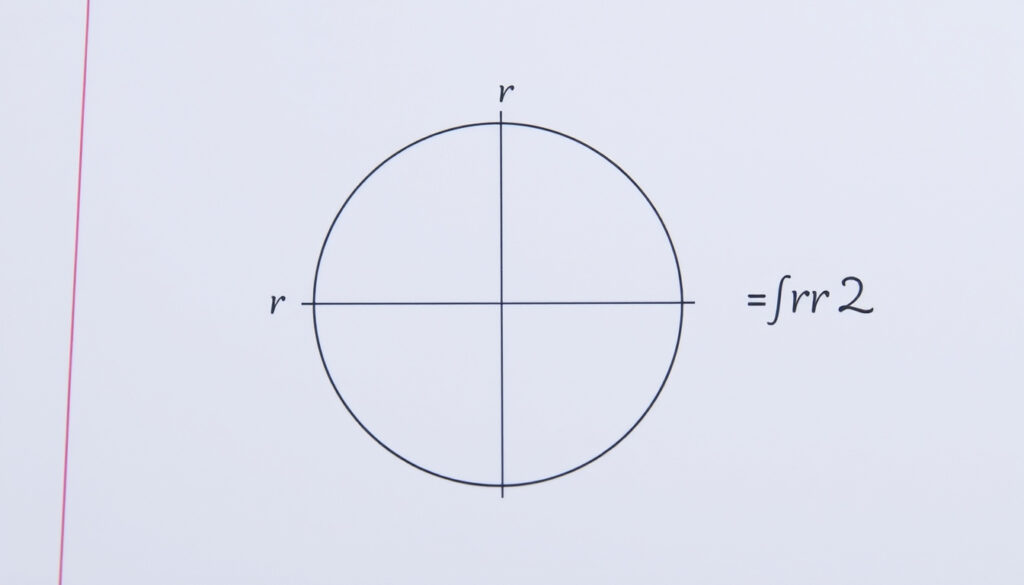
The fundamental formula for calculating the area of a circle is A = πr², where r represents the radius of the circle. According to Khan Academy (an educational platform providing free math instruction), this formula tells you the space enclosed within the circle’s boundary. The Greek letter π (pi) represents approximately 3.14159, the constant ratio of any circle’s circumference to its diameter (Wikipedia, encyclopedic reference).
Standard formula with radius
The radius is the distance from the center of the circle to any point on its circumference. When you square the radius and multiply by π, you get the total area. For example, a circle with a radius of 5 units has an area of π × 5² = 25π ≈ 78.54 square units.
Role of pi
Pi appears because the area of a circle scales proportionally with the square of its radius. The ratio between a circle’s circumference and its diameter is always π, regardless of the circle’s size. This constant was first systematically studied by Anaxagoras, who around 450 BC became the first recorded mathematician to investigate circle area problems (MacTutor History of Mathematics, academic historical resource).
The pattern holds across all circles: double the radius, and the area quadruples. This mathematical relationship was formalized by Eudoxus of Cnidus in the fifth century BC, who proved that the area of a disk is proportional to the square of its radius (Wikipedia).
Archimedes’ insight from approximately 260 BCE still shapes how we teach circle calculations today: area equals half the circumference multiplied by the radius, which simplifies to πr² (Wikipedia).
How do you find area with diameter?
When you know the diameter but not the radius, the process requires one extra step. Since the radius equals half the diameter (r = d/2) (Math Open Reference, geometry education resource), you substitute this relationship into the standard formula.
Formula A = π(d/2)²
The diameter-based formula is A = π(d/2)². This expands to A = π × (d²/4) or equivalently A = (πd²)/4. Both formulations produce identical results—the choice depends on which feels more intuitive for your calculation.
Step-by-step example
Consider a circle with a diameter of 10 units:
- Step 1: Find the radius: r = 10/2 = 5 units
- Step 2: Square the radius: 5² = 25
- Step 3: Multiply by π: A = π × 25 = 25π ≈ 78.54 square units
Alternatively using the diameter formula directly: A = π(10/2)² = π × 25 = 25π. The circumference formula follows similarly: C = πd or C = 2πr depending on what measurement you start with (Study.com, educational platform).
The implication: any time you’re given the diameter, simply halve it to unlock the full area calculation.
How do you calculate circle area?
The most common approach follows three straightforward steps, whether you’re working from a radius or converting a diameter first.
Using radius
If you start with the radius directly, the calculation is immediate:
- Identify the radius value from your problem
- Square the radius (multiply it by itself)
- Multiply the result by π (approximately 3.14159 or use 22/7 for exact fractions)
For a circle with radius 3 units: A = π × 3² = 9π ≈ 28.27 square units. (Study.com)
Practical examples
Real-world applications include calculating the surface area of circular tables, garden plots, or pizza sizes. A 14-inch diameter pizza has radius 7 inches, giving an area of π × 7² = 49π ≈ 153.94 square inches—useful when comparing deals across different sized pizzas.
The method of exhaustion, pioneered by Archimedes around 260 BCE, proved this formula rigorously by showing that a circle’s area equals that of a right triangle with base equal to the circumference and height equal to the radius (Wikipedia). This geometric proof remains foundational in mathematics education.
What this means: mastering these three steps—identify, square, multiply—handles virtually any circle area problem you’ll encounter.
Can you calculate area with circumference?
Yes, and the derivation reveals the elegant interconnection between a circle’s boundary and its interior space.
Link C = 2πr to area
Starting from the circumference formula C = 2πr, you can solve for the radius: r = C/(2π). Substituting this into A = πr² gives:
A = π × (C/(2π))² = π × C²/(4π²) = C²/(4π)
This formula lets you calculate area directly from circumference. (Wikipedia, mathematical reference)
Solving for r from C
If a circle has circumference of 31.4 units:
- Step 1: r = C/(2π) = 31.4/(2 × 3.14159) ≈ 5 units
- Step 2: A = πr² = π × 25 ≈ 78.54 square units
Alternatively using the direct formula: A = C²/(4π) = (31.4)²/(4 × 3.14159) ≈ 985.96/12.57 ≈ 78.44 square units (slight rounding difference).
The problem of finding circle area using circumference actually helped drive the development of integration in mathematics (MacTutor History of Mathematics). The method of viewing the circle as the limit of regular polygons with increasing sides traces back to Archimedes himself.
Modern calculus students encounter this same derivation when learning integral techniques—the circle served as a prototype problem for developing the mathematics we use today (Wikipedia).
What is the area and perimeter of a circle?
While “perimeter” technically refers to polygonal shapes, for circles we use the equivalent term circumference.
Perimeter as circumference C = 2πr
The circumference formula is C = 2πr when using radius, or C = πd when using diameter (Study.com). This measures the total distance around the circle’s edge. Learn the area of a circle formula at Công thức tính diện tích hình tròn.
Differences from area
Area measures the interior space (πr²), while circumference measures the boundary length (2πr). The key difference: area is expressed in square units, circumference in linear units. A circle with radius 5 units has area of 25π ≈ 78.54 square units and circumference of 10π ≈ 31.42 linear units.
The relationship between these measures runs deep. Archimedes proved that the area equals half the circumference multiplied by the radius—conceptually transforming the curved boundary into a triangular area with base = circumference and height = radius (Wikipedia).
What to watch: many students mix up the exponent—remember that area requires squaring the radius (r²), while circumference uses radius to the first power (r¹). This asymmetry reflects how two-dimensional area scales differently than one-dimensional perimeter.
Step-by-step calculation
Follow this sequence regardless of which measurement you start with:
- Identify your starting measurement — radius, diameter, or circumference
- Convert to radius if needed — divide diameter by 2; divide circumference by 2π
- Square the radius — multiply by itself (r × r)
- Multiply by π — use 3.14159 for decimals, or 22/7 for fractions
- State your answer with correct units — remember area requires square units
Example with diameter: Given a circle with diameter 12 cm
- Radius = 12/2 = 6 cm
- Radius squared = 36 cm²
- Area = π × 36 ≈ 113.1 cm²
Example with circumference: Given a circle with circumference 44 cm
- Radius = 44/(2π) = 44/(6.283) ≈ 7 cm
- Radius squared = 49 cm²
- Area = π × 49 ≈ 153.9 cm²
The catch: rounding π prematurely compounds errors. For precision work, keep π symbolic until the final calculation.
Confirmed facts
- πr² is the universal formula for circle area (Khan Academy)
- Radius equals half the diameter (Math Open Reference)
- Circumference = 2πr (Study.com)
- Archimedes proved the formula circa 260 BCE (Wikipedia)
Rumors and misconceptions
- Confusing area with circumference formulas
- Forgetting to square the radius before multiplying by π
- Using diameter directly in πr² instead of halving first
Historical derivation and proofs
The formula A = πr² wasn’t discovered overnight—it emerged through millennia of mathematical investigation. Anaxagoras began studying circle area around 450 BC (MacTutor History of Mathematics), but it was Archimedes who provided rigorous proof using the method of exhaustion.
“Archimedes used the tools of Euclidean geometry to show that the area inside a circle is equal to that of a right triangle whose base has the length of the circle’s circumference and whose height equals the circle’s radius.”
— Wikipedia contributors
This geometric insight—that the curved circle equals a straight-edged triangle with specific proportions—remains one of mathematics’ most elegant proofs.
“The problem of finding the area of a circle led to the development of integration in mathematics.”
— MacTutor History of Mathematics
The polygon approximation method views the circle as the limit of regular polygons with increasing numbers of sides. As sides increase, the polygon’s area approaches the circle’s area more closely (Wikipedia). Each regular polygon’s area equals half its perimeter times its apothem (distance from center to sides)—when the apothem becomes the radius and the perimeter approaches the circumference, you get A = ½ × C × r = πr².
The square (r²) in the circle’s area formula reflects two-dimensional scaling—yet circles themselves have no straight edges. This geometric truth emerged from a method that approximated curves using increasingly smaller straight segments, a technique that later became fundamental to calculus (Wikipedia).
Summary
The area of circle formula—A = πr²—connects to diameter and circumference versions through simple algebraic relationships. Starting from any given measurement (radius, diameter, or circumference), you can derive the area through a few arithmetic steps. This formula’s roots trace back to ancient Greek mathematicians, with Archimedes providing the definitive proof around 260 BCE that still holds today.
For students and professionals alike, the formula’s practical value is clear: whether calculating pizza sizes, garden plots, or engineering components, knowing how to switch between radius, diameter, and circumference measurements ensures you solve the right problem correctly.
Related reading: Combined Science O Level Tuition · Marine Parade Tuition Centre
Frequently asked questions
What formula is 2 * pi * r?
2πr is the formula for circumference, not area. This calculates the distance around the circle’s edge. The area formula is πr²—note the exponent on the radius.
Is 2πr the same as circumference?
Yes. The circumference of a circle equals 2πr when using the radius, or πd when using the diameter. Both formulations are equivalent since r = d/2.
Why is it 2πr?
The circumference formula C = 2πr comes from the definition of π as the ratio of circumference to diameter (π = C/d). Rearranging gives C = πd = π(2r) = 2πr.
What is a formula for a circle?
In analytic geometry, the Cartesian equation for a circle centered at the origin is x² + y² = a², where a is the radius. The area formula remains A = πa² (MacTutor History of Mathematics).
What are the two formulas for area?
The two common area formulas are A = πr² (using radius) and A = π(d/2)² or equivalently A = πd²/4 (using diameter). A third version using circumference: A = C²/(4π).
Is the circumference 3.14 times the diameter?
Yes, approximately. Since π ≈ 3.14159, the circumference equals π times the diameter (C = πd). The approximation 3.14 works for everyday calculations where extreme precision isn’t required.
What is Area in Math?
Area is the measurement of space enclosed within a two-dimensional boundary. For circles, it represents the interior surface and is measured in square units (Wikipedia).
More related posts
 Din Tai Fung Jewel: Location, Menu, Prices & Reviews
 What Is JPG vs PNG? Differences, Uses, and Which Format to Choose
 Choi Min-ho Biography: SHINee, Dramas, Physical 100
 Auspicious Day to Start Work in 2026: Top Feng Shui Dates
 Gold 916 Price Singapore: Today’s 22K Rate
 Indian Super League Games – Live Scores, Fixtures and Standings
 NTU Graduation Date 2025: Nanyang & Nottingham Trent
 How to Glaze Donuts: Simple Recipes for Perfect Glaze