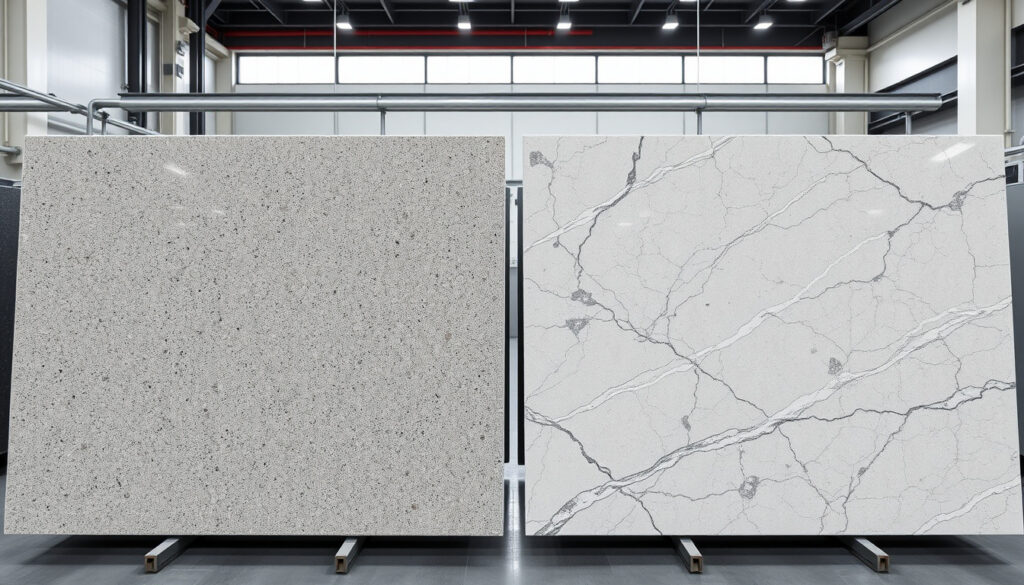
Sintered Stone in Chinese: Name, Production, vs Quartz Guide
If you’ve been comparing countertop materials lately, you’ve probably stumbled across something called sintered stone — and possibly seen it labeled with Chinese characters you couldn’t pronounce. The term, (Yán bǎn), shows up on supplier catalogs, architectural specs, and import listings, often with little explanation of what it actually is or where it comes from. This guide cuts through the terminology, the manufacturing story centered on China, and how this material stacks up against the quartz countertops already dominating Western kitchens.
Chinese name: (Yán bǎn) · Origin: China leads global production · Firing temp: >1200°C · Mohs hardness: 7–8 · Typical uses: Countertops, kitchen tops, dining tables
Quick snapshot
- Sintered stone is called (Yán bǎn) in Chinese (Edison Stone)
- Made from 100% natural minerals, no resins (Carmel Imports)
- Pressures exceed 10,000 tons; firing above 1200°C (Kungfu Stone)
- Exact pricing variations across regions and suppliers
- Whether “healthiest countertop” claims are independently verified
- Long-term warranty data from Chinese manufacturers
- China’s sintered stone industry accelerated rapidly post-2015 (Kungfu Stone)
- China has over 100 quartz stone manufacturers exporting globally (Kungfu Stone)
- 2025 positioning favors sintered stone for premium projects (XMY Eyang)
- Continued growth in outdoor kitchen applications
- Thinner panel options (6mm) expanding design possibilities
- China sourcing becoming standard for cost-conscious projects
| Property | Value |
|---|---|
| Chinese Term | (Yán bǎn) |
| Origin Leader | China manufacturers |
| Mohs Hardness | 7–8 |
| Texture | Natural stone-like |
| Strengths | Hardness, wear resistance |
| Composition | 100% natural minerals, no resins |
What is sintered stone called in Chinese?
In China, sintered stone goes by a few names depending on the context. The most common term is (Yán bǎn), which literally translates to “rock slab” or “stone panel.” Manufacturers and trade listings also use “porcelain stone” or “large porcelain slabs” when describing sintered stone products in the Chinese market.
(Yán bǎn) definition
refers to ultra-compact surfaces produced through high-temperature sintering of natural raw materials including feldspar, clay, and silica. The process creates a dense, non-porous material that mimics natural stone while offering superior durability. Unlike quartz, which uses resin as a binder, contains no synthetic polymers — it’s made entirely from minerals that fuse under extreme heat and pressure.
Pronunciation guide
The pinyin pronunciation is Yán bǎn. The first character, , means rock or cliff (pronounced “yán” with a rising tone). The second character, , means slab or board (pronounced “bǎn” with a falling-rising tone). Together, the term describes the material’s essential nature: a stone-like slab produced through industrial processes.
Suppliers frequently list under English translations like “porcelain stone slab” or “sintered stone panel.” When sourcing from Chinese manufacturers, searching both the Chinese characters and these English equivalents will surface a broader range of products.
Production and application of sintered stone in China
China has emerged as a dominant force in sintered stone production, leveraging advanced manufacturing capabilities and economies of scale that smaller producers cannot match. The industry developed rapidly following the 2010s, with factories investing in presses exceeding 10,000 tons of pressure and kilns capable of firing above 1200°C.
Manufacturing process
The production process begins with natural raw materials — feldspar, quartz, clay, and other minerals — that are finely ground and blended. This mixture is then pressed at extreme pressures (typically over 10,000 tons, often exceeding 15,000 tons) to form a dense compact. The pressed slab travels through a kiln where temperatures above 1200°C cause the particles to sinter and fuse without fully melting. The result is a homogeneous, non-porous surface with no resin content.
China now has over 100 quartz stone manufacturers alone, most exporting high-quality products to the US and Canada. Sintered stone production runs alongside this established infrastructure, with some facilities producing both materials on adjacent lines.
Key applications
Sintered stone from Chinese manufacturers serves multiple applications across residential and commercial projects. Countertops remain the primary use, particularly in kitchens where the material’s heat and scratch resistance prove valuable. Beyond countertops, manufacturers produce panels for flooring, wall cladding, bathroom vanities, and even furniture surfaces. Thinner gauges (6mm and 12mm) open applications like cabinet door panels and integrated appliance surrounds that would be impractical with thicker quartz slabs.
Is sintered stone from China good?
The quality of Chinese sintered stone varies more widely than products from established European brands, but reputable manufacturers produce material that rivals or exceeds international standards. The key distinction lies in supplier selection: some factories prioritize cost over consistency, resulting in slabs that lack the hardness and durability characteristics that define premium sintered stone.
Durability factors
When sourced from established manufacturers, Chinese sintered stone demonstrates exceptional durability characteristics. Mohs hardness scores of 7–8 place it ahead of most quartz products (typically 6–7) on the scratch resistance scale. The non-porous composition resists staining and moisture penetration without sealing. Heat resistance stands out as a particular strength — the material tolerates direct contact with hot pans, unlike quartz which can suffer resin damage from temperatures above certain thresholds.
Reputable manufacturers
Several Chinese manufacturers have built strong export businesses serving North American and European markets. These suppliers typically offer consistent quality, provide technical documentation, and stand behind their products with warranties. Buyers should request samples, verify production certifications, and confirm specifications match published claims before committing to large orders.
Some Chinese factories produce large-format porcelain slabs marketed as sintered stone that don’t meet the technical specifications of true ultra-compact material. Always verify the manufacturing process — particularly pressure and temperature specifications — when comparing products and prices.
Which is better, quartz or sintered stone?
The answer depends on application, budget, and performance priorities. Sintered stone offers superior durability in demanding conditions, while quartz provides easier fabrication and a more mature supply chain for large commercial projects.
Key differences
The fundamental difference lies in composition and manufacturing. Sintered stone uses 100% natural minerals sintered at high temperatures, creating a fully homogeneous material with no resin content. Quartz combines crushed quartz crystals (typically 90–95%) with polyester resin binder, creating an engineered surface that performs well but has thermal and chemical limitations. Sintered stone’s Mohs hardness of 7–8 exceeds quartz at 6–7, translating to better scratch resistance in daily use.
Heat resistance represents a critical practical difference. Sintered stone withstands direct contact with hot cookware without damage, making it practical for busy kitchens where pans move from stove to counter. Quartz manufacturers explicitly advise against placing hot pots directly on surfaces due to potential resin damage — a limitation that affects real-world kitchen workflows.
Five categories of specs matter most when comparing these materials: hardness, thermal performance, thickness options, composition, and application range. The data reveals a clear pattern: sintered stone leads on physical performance metrics, while quartz maintains advantages in cost, fabrication accessibility, and design variety.
These specifications reveal the fundamental differences in how sintered stone and quartz are manufactured and perform in practice.
| Specification | Sintered Stone | Quartz | Source |
|---|---|---|---|
| Mohs Hardness | 7–8 | 6–7 | Edison Stone, Qanvast |
| Firing Temperature | >1200°C | N/A (room temp press) | Kungfu Stone |
| Press Pressure | >10,000 tons | High-temp pressing | Kungfu Stone |
| Thickness Options | 6mm / 12mm / 20mm | 15mm / 20mm / 30mm | XMY Eyang |
| Composition | 100% natural minerals, no resins | Crushed quartz + polyester resin | Carmel Imports, Edison Stone |
| Heat Resistance | Safe for direct hot pan contact | Not recommended for hot pots | Edison Stone, XMY Eyang |
| UV Resistance | UV stable; suitable outdoor | May fade outdoors | Edison Stone |
| Sealing Required | No | No (but porous vs resin binder) | NT Pavers |
| Typical Applications | Countertops, floors, walls, outdoor | Indoor countertops, vanities, backsplashes | NT Pavers |
| Fabrication Complexity | Higher; specialized equipment needed | Easier; mature processes | XMY Eyang |
| Cost Position | Generally higher | Generally lower | Dituo Tiles, NT Pavers |
| China Manufacturer Count | Growing rapidly | >100 factories | Kungfu Stone |
Pros and cons
Upsides
- Superior scratch resistance (Mohs 7–8 vs quartz 6–7)
- Heat safe for direct hot pan contact
- UV stable for outdoor applications
- No sealing required; non-porous from production
- 100% natural minerals; fully recyclable
- Thinner panel options (6mm) for design flexibility
Downsides
- Higher cost due to complex manufacturing
- Brittle; requires careful handling and expert installation
- Fewer color/pattern options than established quartz lines
- Mature global supply chain less developed than quartz
- Fabrication requires specialized equipment
- Quality varies more widely among Chinese manufacturers
What is sintered stone used for?
Sintered stone serves applications ranging from kitchen countertops to outdoor architectural panels. Its versatility stems from the combination of durability, thin-gauge options, and resistance to environmental factors that limit quartz to indoor use.
Countertops
Kitchen countertops represent the largest application category. The material’s heat resistance allows placing hot cookware directly on surfaces, while its scratch resistance handles daily cutting and sliding. Bathroom vanities benefit similarly from moisture and stain resistance. Commercial applications in restaurants and hospitality venues capitalize on the durability and easy maintenance characteristics.
Kitchen and dining
Beyond traditional countertops, sintered stone appears in dining tables, island surfaces, and integrated kitchen panels. The 6mm and 12mm thickness options enable seamless vertical applications like full-height backsplashes and cabinet panels that would be impractical with 20mm+ quartz slabs. Outdoor kitchen surfaces represent a growing application area where quartz’s UV limitations make sintered stone the clear choice.
“Sintered stone is significantly more heat-resistant than quartz, making it suitable for direct contact with hot surfaces.”
— Edison Stone (Supplier)
“For commercial projects that plan to buy stone countertops in large quantities, quartz stone is obviously a more stable and cost-effective option.”
— XMY Eyang (Industry Analyst)
“It’s clear that the former [sintered stone] is far superior in terms of versatility and resistance to external elements.”
— Qanvast (Home Editorial)
Related reading: Sintered Stone Countertops vs Quartz Stone Countertops in China · China Porcelain Stone Sintered Slab vs Quartz
Frequently asked questions
What is sintered stone called in Chinese?
Sintered stone is called (Yán bǎn) in Chinese, which translates literally to “rock slab.” Manufacturers also use terms like “porcelain stone” or “large porcelain slabs” when describing this material in trade contexts.
Is sintered stone from China good?
Chinese-manufactured sintered stone from reputable suppliers meets or exceeds international quality standards. The key is verifying specifications — pressure, temperature, and hardness ratings — and sourcing from established exporters rather than discount intermediaries. Quality varies among factories, so samples and documentation review are essential for larger projects.
Which is better, quartz or sintered stone?
Neither material wins universally. Sintered stone excels in heat resistance, scratch resistance, and outdoor durability. Quartz offers lower cost, easier fabrication, and wider design options. For high-end residential kitchens prioritizing performance, sintered stone typically wins. For large commercial projects prioritizing budget and speed, quartz often makes more sense.
What is sintered stone used for?
Primary applications include kitchen countertops, bathroom vanities, dining tables, and outdoor kitchen surfaces. Thinner panels (6mm, 12mm) enable wall cladding, cabinet panels, and integrated furniture surfaces. The material’s outdoor suitability makes it increasingly popular for patios, pool surrounds, and exterior architectural panels.
What are the downsides of sintered stone?
The main disadvantages are higher cost compared to quartz, more complex fabrication requiring specialized equipment, brittleness that complicates handling and installation, and wider quality variation among Chinese manufacturers. The material’s hardness also means edge chips are difficult to repair without replacement.
What makes sintered stone durable?
Durability stems from the manufacturing process: extreme pressure (10,000+ tons) and high temperature (>1200°C) create a fully dense, homogeneous material with no internal weak points. The absence of resin means no chemical degradation under heat or UV exposure. Mohs hardness of 7–8 exceeds most common kitchen hazards, while the non-porous surface resists staining without sealing.
Is sintered stone suitable for kitchens?
Yes — for many kitchen applications, sintered stone outperforms quartz. Heat resistance allows direct hot cookware placement. Scratch resistance handles daily food preparation. Non-porous composition resists staining from common kitchen substances. The main consideration is cost: expect to pay more than comparable quartz surfaces while receiving superior long-term durability.
More related posts
 What Is a Root Canal? Procedure, Pain, Cost in UK & Recovery
 Yo-Yo Ma Singapore – 2025 Concert Dates and Tickets
 Lady Gaga Singapore Concert 2025: Dates & Setlist Guide
 Hong Kong Airport Spotted: Best Plane Spotting Locations
 Lasalle College of the Arts – Singapore’s Arts College Guide
 Hotel Royal Signature Kuala Lumpur: Location, Reviews & Booking
 Micron Semiconductor Asia Pte Ltd: Profile Singapore Ops & Careers
 Saham dengan Penurunan Terdalam: Deepest IDX Stock Declines