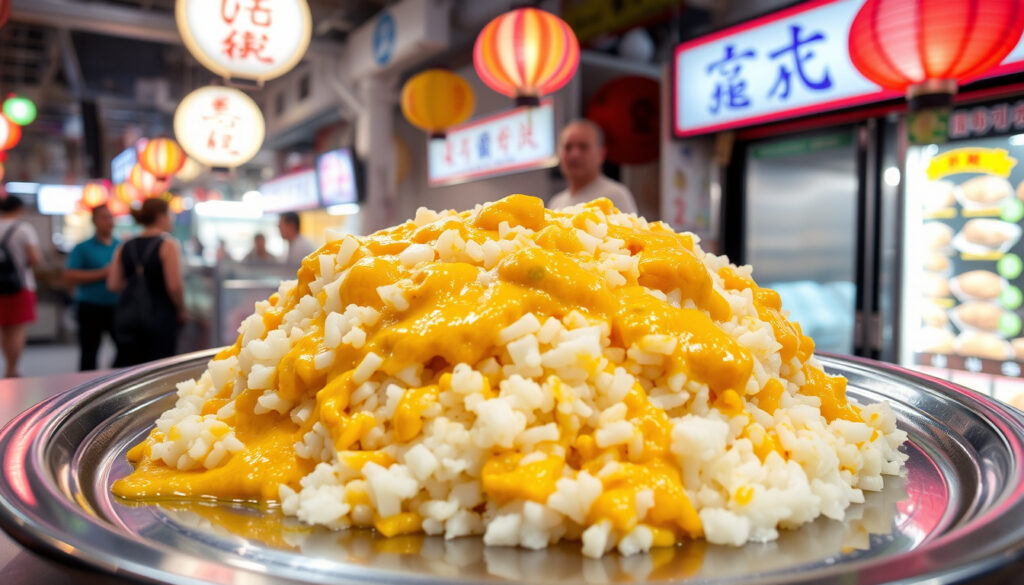
Scissor Cut Curry Rice: Singapore’s Gooey Hawker Delight
Scissor cut curry rice is a late-night ritual—gooey chicken curry, braised pork, and silky cabbage gravy, all assembled with a snip of kitchen scissors. The Beach Road version, run by a family since the 1930s, represents pure Singapore—a dish born from Hainanese immigrants who had no such recipe back home.
Origin: Singapore Hainanese style · Typical Price: $3–$5 SGD · Open Hours Example: 11 am – 3:30 am daily · Address Example: 229 Jalan Besar, Singapore 208905 · Key Toppings: Chicken cutlet, braised pork, cabbage gravy
Quick snapshot
- Plate of rice topped with gooey chicken curry, braised pork and slimy soft cabbage gravy (Johor Kaki food blog)
- Hainanese curry rice style in Singapore (Spring Tomorrow cultural guide)
- Exact current operational status of secondary stalls beyond Beach Road
- Whether recipe variations across locations represent meaningful cultural drift
- 1930s: Beach Road stall established; migrated to Jalan Besar decades later (Singapore Atrium Sale history article)
- Late 1940s: Mr Lee Shi Su credited as first known hawker to offer the dish at Clyde Terrace Market (Makansutra hawker authority)
- Beach Road stall continues under 4th generation owner Ben as late-night institution
- Other locations may expand or close depending on market demand
The specification table below summarizes the core details verified across multiple sources.
| Field | Value |
|---|---|
| Main Stall | Beach Road Scissor Cut Curry Rice |
| Address | 229 Jalan Besar, Singapore 208905 |
| Hours | 11 am – 3:30 am daily |
| Price | $3–$5 SGD |
| Style | Hainanese with gooey curry and toppings |
| Founding | 1930s |
| Current Owner | 4th generation, Ben |
| Signature Sauces | Curry and dark braised pork sauce |
What is scissor cut curry rice?
Scissor cut curry rice is a Singapore hawker staple built on contradiction. It looks simple—rice, curry, some meat, a bit of greens—but every bite carries layers. The dish combines Western fried pork chops with Nyonya curry chicken, Indian curry spices, and Chinese braised gravy all slathered over rice, held together by a medley of sauces that vary by stall but always include a rich Hainanese curry and a lighter braised version (Johor Kaki).
What makes it distinct is texture. The cabbage isn’t crisp—it’s soft, almost melted, swimming in the gravy. The meat, whether pork cutlet or chicken chop, gets diced with scissors directly onto the rice so the pieces fall unevenly, each delivering a different ratio of meat to sauce to rice. A plate typically includes pork belly, curry chicken, and that signature cabbage, all bathed in two secret sauces: curry and dark braised pork (TripAdvisor).
Description and origins
The dish was invented in British Malaya in the early 1900s—not in Hainan, China, where Hainanese immigrants came from (Johor Kaki). In fact, there is no scissor cut curry rice in Hainan island itself; locals would give you a blank stare if you asked. The dish emerged when Hainanese immigrants, many of whom worked as cooks for the British colonial administration, adapted their culinary training to local ingredients and the multicultural palates of Singapore and Malaysia (Singapore Atrium Sale).
Key ingredients and preparation
- Rice drenched in Hainanese curry and braised sauce
- Pork cutlet or chicken chop, cut with scissors
- Soft cabbage swimming in gravy
- Optional extras: luncheon meat, fried egg, sardines, prawn fritters
- Chili sauce on the side for heat
Why is it called scissors cut curry rice?
The name is literal. At most stalls, including the Beach Road original, the cook takes a pair of kitchen scissors and snips the meat and cabbage directly over the rice. No cleavers, no spoons—just scissors. The technique became the dish’s defining visual (Singapore Atrium Sale).
The cutting technique
The switch from cleavers to scissors reportedly happened in the 1930s. According to food blogger I Eat I Shoot I Post, the great-grandfather of the current owner found that fights at the stall often escalated when someone grabbed a cleaver. Scissors were harder to weaponize, so the tradition shifted—and stayed (I Eat I Shoot I Post). The story illustrates something about hawker culture: practicality often shapes ritual.
Singapore hawker tradition
Singapore’s hawker scene has always been a laboratory of fusion. Hainanese curry rice reflects this—it borrows from Malay, Chinese, Peranakan, and Western cooking traditions without belonging exclusively to any of them (Makansutra). The variety of toppings alone—pork chops, sardines, fried eggs, prawn fritters, meat cakes, Nonya assam fish—shows the dish wasn’t designed to follow rules.
Is scissor cut curry rice closing down?
The Beach Road flagship at 229 Jalan Besar continues operating under 4th generation owner Ben, serving late-night crowds from 11 am to 3:30 am daily (Migrationology food guide). The stall has held its position at #1,447 out of 11,675 restaurants in Singapore on TripAdvisor, a ranking that reflects consistent quality rather than peak popularity (TripAdvisor).
Recent news on stalls
Reports indicate that a scissor cut curry rice stall in Geylang may be facing closure, though exact timelines and details remain unclear. Secondary locations at Upper Thomson and Yishun have reportedly opened in recent years, suggesting the dish is expanding rather than disappearing entirely. The Singapore Hainan Hwee Kuan, a 171-year-old clan association founded in 1854, also serves a version of the dish priced at $6.80 for pork chop or chicken cutlet curry rice (Olive and Write heritage guide).
Status of popular locations
- Beach Road Scissors Cut Curry Rice: Open, 229 Jalan Besar, 11 am – 3:30 am
- Upper Thomson Road: Newer location, reportedly opened 2025
- Yishun Ave 5: Ex-chef operated, 10 am – 7:30 pm
- Geylang: Closure reportedly pending
Late-night seekers find that the Beach Road stall delivers the most reliable experience—the one that stays open when everywhere else has washed the dishes.
Scissor cut curry rice menu and prices
Pricing at the Beach Road stall ranges from $3 to $5 SGD depending on how many toppings you order (Migrationology). A plate with chicken and cabbage sets you back $5; add luncheon meat for another $5. A full pork chop and chicken chop set comes in under $10 (TripAdvisor).
Popular stalls and items
- Beach Road Scissors Cut Curry Rice: Pork cutlet, chicken chop, braised pork belly, curry chicken, cabbage
- Singapore Hainan Hwee Kuan: Pork Chop Curry Rice, Chicken Cutlet Curry Rice ($6.80)
- Yishun location: Run by ex-chefs, similar menu, earlier closing hours
Pricing range
At Beach Road, expect to pay $3–$5 SGD for a basic plate, with combo sets under $10. The Singapore Hainan Hwee Kuan version sits slightly higher at $6.80. MRT access is convenient: Lavender or Farrer Park stations are within walking distance of the Beach Road stall (Migrationology).
Budget-conscious diners discover that scissor cut curry rice offers one of Singapore’s most satisfying late-night meals at these price points—hot, filling, and free of tourist markup.
Scissor cut curry rice recipe
Home replication is possible but requires patience. The dish lives and dies on sauce balance—the curry can’t be too thin, the braised gravy needs body, and the cabbage must absorb both without becoming mush. Here’s how to build a version that echoes the hawker original.
Ingredients list
- Steamed white rice, slightly sticky
- Curry sauce: coconut milk base with turmeric, cumin, coriander, lemongrass, dried chilies
- Braised pork sauce: soy, dark soy, star anise, cinnamon, rock sugar
- Pork cutlet or chicken chop: marinated, flour-dusted, deep-fried
- Cabbage: blanched or braised in curry until soft
- Chili sauce for serving
Step-by-step preparation
- Build the curry: Fry aromatics (shallots, garlic, ginger) in oil until fragrant. Add dry spices—turmeric, cumin, coriander, chili flakes—and stir for 2 minutes. Pour in coconut milk and simmer for 30 minutes until thick.
- Prepare the braised sauce: Combine soy sauce, dark soy, star anise, cinnamon, and rock sugar in a saucepan. Simmer 20 minutes until syrupy. Strain if needed.
- Cook the protein: Pound pork chops or chicken breasts thin. Season with salt and pepper, dust with flour, and deep-fry at 180°C until golden and crispy. Rest briefly, then cut with scissors into rough pieces.
- Braise the cabbage: Add shredded cabbage to the curry pot and simmer 10–15 minutes until soft and saturated.
- Plate and serve: Place rice in a shallow bowl. Arrange cabbage, then meat pieces. Drench generously with both sauces. Serve with chili sauce on the side.
Amateur cooks quickly learn that achieving the correct sauce viscosity determines whether the dish tastes authentic or falls flat.
Timeline
The timeline below traces key milestones from the 1854 founding of the Singapore Hainan Hwee Kuan through recent stall openings.
| Year | Event |
|---|---|
| 1854 | Singapore Hainan Hwee Kuan founded by clan members from Qiongzhou county, Hainan |
| 1870s | Hainanese immigrants arrive in Singapore; other Chinese clans already occupy Chinatown |
| 1900s | Hainanese curry rice invented in British Malaya—no equivalent exists in Hainan itself |
| 1930s | Beach Road Scissors Cut Curry Rice established as street-side stall; scissors replace cleavers due to gang violence |
| Late 1940s | Mr Lee Shi Su becomes first known hawker to offer scissor-cut curry rice at Clyde Terrace Market |
| 2008 | ieatishootipost review raises Beach Road stall’s profile online |
| 2022 | Legend Scissors Cut Curry Rice opens in Yishun |
| 2023 | Beach Road stall under 4th generation owner Ben |
| 2025 | Scissor-Cut Curry Rice location reported at Upper Thomson |
Upsides
- Authentic late-night Singapore hawker experience unavailable elsewhere
- Four-generation family tradition with consistent quality
- Budget-friendly at $3–$5 SGD per plate
- Accessible via Lavender or Farrer Park MRT
- Open until 3:30 am—rare for quality food at that hour
Downsides
- No-frills shophouse environment—seating and comfort not priorities
- Limited menu customization compared to modern food courts
- Sauce-heavy preparation not ideal for health-conscious diners
- Secondary stall locations may be harder to verify for quality
What people say
“The sticky, gooey, unthinkable mixture that they heap onto a plate of rice is a texture that seems impossible to achieve at home.”
— I Eat I Shoot I Post (Singapore food blog)
“Hainanese curry rice has no true Indian roots, as evidenced by the variety of toppings offered at curry rice stalls including pork chops, sardines, fried eggs, prawn fritters, meat cakes, and Nonya style assam fish.”
— Makansutra (Singapore hawker authority)
“This style of eating originated from Hainanese immigrants who worked as cooks for the British and adapted their culinary techniques to local ingredients and tastes.”
— Singapore Atrium Sale
The implications run deeper than taste. Scissor cut curry rice is a dish without a homeland—created by immigrants who left Hainan and built something new in Singapore that their ancestors never made. That origin story is now part of the city’s culinary identity. For visitors, the dish offers a taste of Singapore’s colonial food culture. For locals, it’s a reminder that some of the city’s best food was invented by people who came from nothing and had everything to prove.
Related reading: Bendemeer Market & Food Centre – Best Hawker Stalls and Visitor Guide · Mr Grumpy Nasi Ayam – Singapore Locations Menu Guide
In the same bustling hawker centers, Katong Mei Wei chicken rice has drawn loyal queues for over three decades with its second-generation Hainanese recipe.
Frequently asked questions
Where is scissor cut curry rice near me?
The main verified location is Beach Road Scissors Cut Curry Rice at 229 Jalan Besar, Singapore 208905, near Lavender and Farrer Park MRT stations. Additional reported locations exist at Upper Thomson Road, Yishun Ave 5, and near the Singapore Hainan Hwee Kuan on Beach Road. Check opening hours before visiting secondary stalls.
What does scissor cut curry rice taste like?
The dish delivers a combination of crispy fried protein (pork cutlet or chicken chop), tender braised meat, and soft cabbage, all tied together by two contrasting sauces—a rich Hainanese curry and a sweeter dark braised pork gravy. The rice soaks up everything, creating a sticky, saucy bowl with every bite delivering varied textures and flavors.
Is scissor cut curry rice Hainanese?
Yes in origin—the dish was invented by Hainanese immigrants in British Malaya in the early 1900s. However, the dish as served in Singapore is purely a Singapore creation; there is no equivalent recipe in Hainan island itself. The Hainanese community adapted their culinary training to local ingredients, creating something entirely new.
How much is scissor cut curry rice?
At Beach Road Scissors Cut Curry Rice, prices range from $3 to $5 SGD for a plate. A full combo set with pork chop and chicken chop is under $10. The Singapore Hainan Hwee Kuan version is priced at $6.80.
What type of rice is best for curry rice?
Steamed white rice with slight stickiness works best—it holds the saucy gravy without becoming mushy. Long-grain varieties tend to dry out; short or medium grain captures the curry and braised sauce more effectively. The rice should be hot and fresh, as the contrast with room-temperature sauces creates the layered eating experience.
Is katsu curry rice healthy?
Scissor cut curry rice is not typically classified as health food—it’s high in carbohydrates from the rice and fried protein, with calorie-dense sauces. The dish offers protein from the meat and some fiber from the cabbage, but it’s best enjoyed as an occasional indulgence rather than a daily meal. For health-conscious diners, requesting less sauce or skipping the fried protein in favor of grilled options may reduce calorie intake.
Can diabetic patients eat rice at night?
Diabetic individuals should consult healthcare providers about carbohydrate intake timing. Scissor cut curry rice is carbohydrate-heavy, so portion control matters. Pairing with vegetables, choosing smaller portions, and monitoring blood sugar levels after eating are practical strategies. The dish’s late-night serving hours also create timing considerations for those managing blood sugar.
More related posts
 Shanghai Weather in May: Temps, Rain & What to Pack 2026
 Best Ajo Blanco Near Me: Recipe, Ingredients & Where to Eat
 Mr Grumpy Nasi Ayam – Singapore Locations Menu Guide
 Moviesda 2025 Tamil Movie Download: Lists and Risks
 Part Time Jobs Singapore Students: Salary, Legal Rules & Budget
 Wings of Time Show 2025: Tickets, Times, Worth It
 S&CC Rebate 2026: Eligibility, Amount and Dates
 Royal Canin Dog Food: Reviews, Prices & Vet Insights