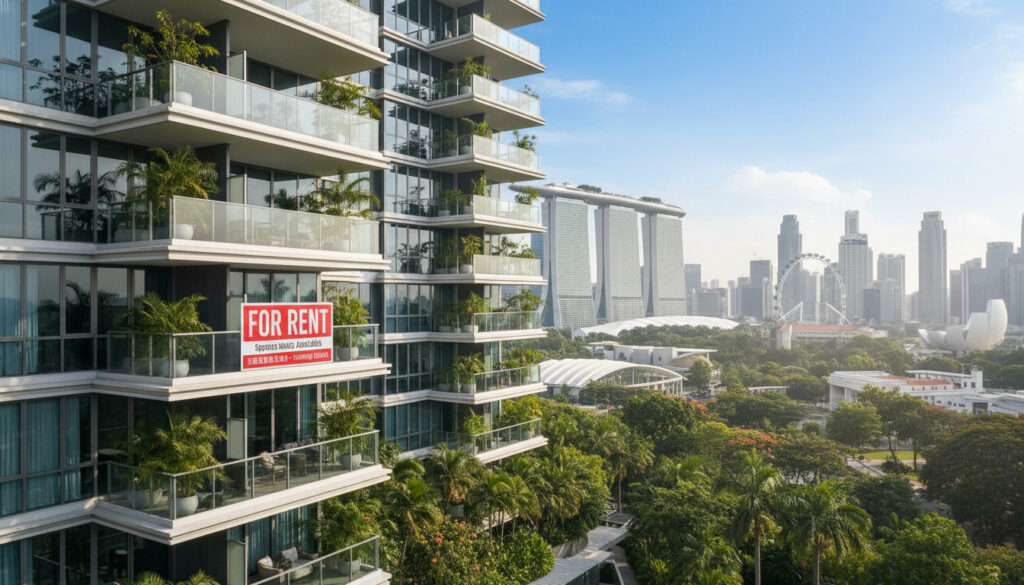
House for Rent in Singapore – 2025 Prices, Areas and Guide
Singapore’s rental market has shifted decisively in favor of tenants after years of relentless growth. Following a 60 percent surge over three years, island-wide rental indices have retreated 4 percent across the last four quarters, with prices easing 5–10 percent through 2024 and 2025. This cooling trend arrives as new housing supply enters the market and leasing activity adjusts to post-pandemic norms.
For expatriates and local families navigating the landscape, options span from government-subsidized HDB flats averaging under S$2,000 monthly to luxury condominiums commanding upwards of S$5,000. The choice between public housing efficiency and private amenities involves weighing location priorities, eligibility constraints, and long-term budget forecasts in a city where rental costs typically consume the largest share of living expenses.
How Much Does It Cost to Rent a House in Singapore?
HDB Flats
Government-subsidized units ranging from S$1.92K–S$1.99K on average. Single rooms start at S$500, while four-room family flats hover between S$2,850–S$4,000.
Condominiums
Private developments with pools and security. Three-bedroom units begin at S$5,100 monthly, with five-bedroom configurations averaging S$4,733–S$5,000.
Private Apartments
City-center one-bedroom units command S$2,500–S$4,000, while equivalent units outside the center cost S$1,500–S$2,500. Three-bedroom family homes in the CBD average S$5,282.
Landed Properties
Terrace houses and bungalows offering maximum space and privacy. These command the highest premiums in the market, significantly exceeding condominium pricing.
Key Market Indicators
- Island-wide correction: Rental indices dropped 4 percent over the last four quarters after a historic 60 percent climb
- HDB resilience: Public housing rents grew 0.3 percent monthly in April 2025, with four-room flats rising 0.7 percent while five-room units remained flat
- Forecast trajectory: HDB rents projected to increase 2–4 percent throughout 2025 as supply tightens, though new BTO projects reaching Minimum Occupation Period will moderate growth
- Suburban value: Two-bedroom HDB units in Tampines, Yishun, and Jurong average S$2,000–S$3,500 versus S$4,000–S$5,000 in central districts
- Utility baseline: Monthly gas, electric, and water for an 85m² apartment average S$157, with internet adding approximately S$42
- Transport efficiency: Public transit costs remain modest at S$40–S$50 monthly, allowing location flexibility
- July momentum: Both HDB and condo rents began climbing alongside increased leasing activity by mid-2025
Rental Cost Breakdown by Property Type
| Property Type | Configuration | Average Monthly Rent | Location Context |
|---|---|---|---|
| HDB Single Room | 1 bedroom (shared) | S$500–S$1,800 | Island-wide |
| HDB 2-Room | 1 bedroom | S$1,800–S$2,500 | Suburban/Central |
| HDB 3-Room | 2 bedrooms | S$2,850–S$4,000 | Suburban/Central |
| HDB 4/5-Room | 3+ bedrooms | S$2,850–S$4,000 | Suburban/Central |
| Condo 3-Bed | 3 bedrooms | From S$5,100 | Various |
| Condo 5-Bed | 5 bedrooms | S$4,733–S$5,000 | Various |
| Private Apartment | 1 bedroom (city) | S$2,500–S$4,000 | City Center |
| Private Apartment | 1 bedroom (outside) | S$1,500–S$2,500 | Outside Center |
| Private Apartment | 3 bedrooms (city) | S$5,282 | City Center |
| Private Apartment | 3 bedrooms (outside) | S$3,101 | Outside Center |
Sources: 99.co HDB rental data, Property Review market analysis, Wise cost of living data
What Are the Best Websites and Platforms for House Rentals in Singapore?
Digital marketplaces dominate the property search process, with two major platforms controlling the majority of listings. PropertyGuru currently hosts 8,987 active HDB rental listings alone, offering comprehensive filtering by district, price range, and flat type. Competitor 99.co provides parallel functionality with additional neighborhood analytics and market trend visualizations.
Platform Specialization
While general portals cover the full spectrum of housing stock, specialized agencies focus on expatriate needs and luxury segments. These services often provide furnished short-term options and relocation support, though they typically charge higher service fees than direct landlord arrangements.
Search Strategy Considerations
Effective digital searches require understanding Singapore’s district coding system and the distinction between built-to-order (BTO) flats reaching Minimum Occupation Period and older resale inventory. Listings update frequently, with premium units in CBD and River Valley moving within 48 hours of posting.
Set up instant alerts for specific block numbers or condo names rather than broad district searches. High-demand properties in Tiong Bahru and the CBD receive applications within hours of listing.
Can Foreigners Rent Houses Like HDB in Singapore and What Are the Requirements?
Foreign nationals face a bifurcated eligibility system distinguishing public housing from private property. While private condominiums and landed homes remain fully accessible to non-citizens, HDB flats operate under strict government quotas designed to maintain community stability.
The Foreigner Quota System
HDB imposes a non-citizen quota of 8–11 percent at both neighborhood and block levels. Once the quota fills for a specific block, no additional foreigners may rent there until existing tenancies expire. This policy particularly affects popular expat areas where demand concentrates, creating sporadic availability regardless of market-wide cooling trends.
Private Property Access
Condominiums and landed properties carry no citizenship restrictions, making them the default choice for expatriates facing quota barriers or seeking amenities like swimming pools and 24-hour security. However, these options command premiums of 150–200 percent over comparable HDB units.
Always confirm current foreigner quota status before viewing HDB properties. Agents cannot override block-level limits, and deposits placed on restricted units may be forfeited if eligibility checks fail.
What Are the Best Areas and Types of Houses for Rent in Singapore?
Neighborhood selection balances commute times, school access, and lifestyle preferences against rental budgets. The city-state’s compact geography and efficient rail network allow viable suburban living even for CBD workers.
Housing Type Comparison
HDB flats deliver functional living space near hawker centers and public transport, attracting budget-conscious families and long-term residents. Condominiums offer resort-style facilities but at significantly higher cost. Landed properties provide standalone privacy for multi-generational households or those requiring garden space, though these cluster primarily in quieter eastern and northern districts.
Expat-Friendly Districts
The CBD, River Valley, and Tiong Bahru maintain high foreigner populations due to proximity to international schools and corporate offices. These areas offer walkable amenities but command premium rents. For those seeking Mr Grumpy Nasi Ayam – Singapore Locations Menu Guide and similar local dining experiences, Tiong Bahru provides particularly dense food options alongside residential convenience.
Family-Oriented Suburbs
Tampines, Yishun, and Jurong offer spacious four and five-room HDB flats at 30–40 percent below central district pricing. These mature estates feature established schools, shopping malls, and parks, making them practical for families prioritizing space over nightlife.
While rental consumes the largest budget share, public transport costs remain minimal at S$40–S$50 monthly. Choosing a suburban location with direct MRT access to the CBD often yields net savings despite longer commute times.
What Steps Are Involved in the Rental Process?
- Property Search (1–4 weeks): Digital filtering on major platforms to identify suitable units within budget and quota constraints
- Viewing and Selection (1–2 weeks): Physical inspection of shortlisted properties, verification of furnishing conditions, and confirmation of landlord documentation
- Offer and Negotiation (3–7 days): Submission of Letter of Intent with good faith deposit, followed by lease term discussions
- Tenancy Agreement Execution (1–2 weeks): Legal review of the stamped agreement specifying duration, maintenance responsibilities, and diplomatic clauses
- Security Deposit Transfer: Payment of two months’ rent (standard for one-year leases) held in escrow against damages
- Move-in and Inventory: Photographic documentation of existing conditions, meter readings, and handover of access cards
What Is Definite and Unclear About Singapore Rentals?
Established Facts
- Foreigner quotas for HDB are strictly enforced at 8–11 percent
- Island-wide rental indices dropped 4 percent over four consecutive quarters
- Four-room HDB flats experienced 0.7 percent monthly growth in April 2025
- Condominium three-bedroom units start from S$5,100 monthly
- Utilities for standard 85m² apartments average S$157 excluding internet
- July 2025 data shows renewed upward pressure on both HDB and condo rents
Information Gaps
- Comprehensive statutory tenant rights frameworks beyond basic contract law
- Specific documentation requirements for foreign nationals vary by immigration status
- Standardized agent commission structures and fee schedules
- Exact enforcement mechanisms for foreigner quota violations
- Detailed dispute resolution timelines for security deposit conflicts
How Does the Rental Market Fit Into Singapore’s Housing Landscape?
Public housing has formed the backbone of Singapore’s residential policy since the 1960s, with the Build-to-Order system now entering a critical phase as early-2020s projects reach Minimum Occupation Period. This influx of newly eligible rental stock promises to stabilize HDB pricing despite projected 2–4 percent growth for 2025.
For expatriates, understanding currency dynamics remains essential when budgeting for long-term stays. Those converting Malaysian Ringgit or other regional currencies should consult current exchange resources like 1000 MYR to SGD – Live Rate, Historical Trends and Best Transfer Tips to accurately project housing costs against home-country income sources.
The coexistence of co-living spaces, traditional HDB room rentals, and luxury condominiums creates a segmented market where price-per-square-foot metrics vary by 300 percent across housing types. This diversity allows the city to accommodate single professionals in S$500 rooms while housing executives in S$15,000 bungalows within the same postal district.
What Do Data Sources Reveal About Current Conditions?
“By July 2025, both HDB and condo rents were climbing alongside increased leasing activity, suggesting the market correction may be stabilizing as new supply absorption meets persistent expatriate demand.”
“Rental rules in Singapore are evolving to balance tenant and landlord rights, though the comprehensive public transport system continues to facilitate location flexibility regardless of district choice.”
— Property Review Expat Guide 2025
What Should Renters Remember When Searching?
Prospective tenants should prioritize verifying HDB foreigner quota status before committing deposits, utilize specialized listing platforms for market-rate comparisons, and budget for the 2–4 percent projected HDB rent increases through 2025. While the market has cooled from peak pricing, location premiums in the CBD and River Valley remain substantial compared to suburban alternatives. Finalizing agreements requires careful review of diplomatic clauses for expatriates and photographic inventory documentation to protect security deposits.
Frequently Asked Questions
Is renting a house in Singapore expensive?
Rental costs represent the largest single expense for most residents, though prices have declined 5–10 percent in 2024–2025. HDB flats offer affordable options from S$1,800 monthly, while private housing commands premiums of 150 percent or more.
Can foreigners rent HDB flats in Singapore?
Yes, subject to an 8–11 percent foreigner quota at neighborhood and block levels. Once quotas fill, no additional foreigners may rent in that specific block until existing leases expire.
What is the average rent for a 4-room HDB?
Four-room HDB flats average S$2,850–S$4,000 monthly, with four-room units experiencing the highest recent growth at 0.7 percent monthly in April 2025.
Are utilities included in Singapore rental prices?
Typically no. Tenants should budget S$157 monthly for gas, electricity, and water in an 85m² apartment, plus S$42 for internet connectivity.
What is the minimum lease duration for HDB rentals?
HDB regulations require minimum six-month lease terms for entire flats, though room rentals may have different arrangements. Private properties typically require one-year commitments.
Which is better: HDB or condo for families?
HDB offers superior value and space for families prioritizing budget, while condos provide facilities like pools and gyms at significantly higher cost. Suburban HDB flats in Tampines or Jurong offer family-sized units for S$2,000–S$3,500.
Can foreigners rent landed properties?
Yes, landed houses including terraces and bungalows face no foreign ownership restrictions for rental purposes, unlike HDB public housing which maintains quota limits.
More related posts
 The Queen of News 2: Cast, Release, Watch Online & Ending
 Royal Canin Dog Food: Reviews, Prices & Vet Insights
 English to Chinese Words: Key Phrases, Tones & Numbers
 Ji De Chi Menu: Guide to Singapore’s Popular Dessert Spot
 Thailand Visa for Indians: Free Entry & Costs (2025)
 Buy Used Car Singapore: 2025 Guide to Prices & Platforms
 Condolence Flower Stand Singapore: Best Prices & Delivery