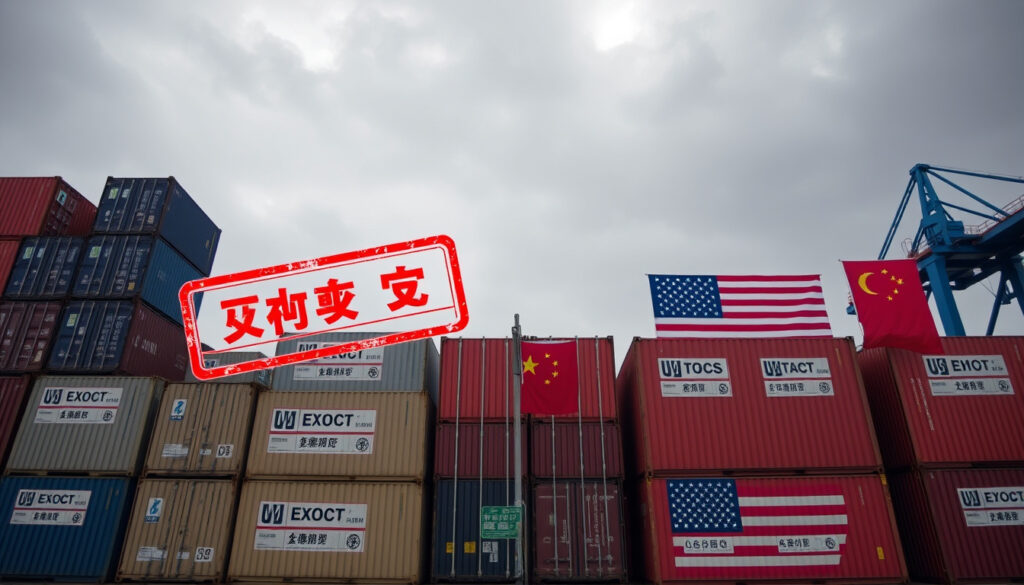
China Export Restrictions on US Firms: Lists and Impacts
Washington built its tech dominance on the assumption that China needed access to American markets more than America needed China’s materials. That assumption is now collapsing, as Beijing flips the script using rare earth dominance and restrictions on US companies to push back against American export controls, creating real headaches for defense contractors, drone makers, and chip equipment firms.
US Companies on China’s Restricted List: Multiple including drone firms · Companies Barred from China: 11 · Recent US Action on Chip Tools: Halt to Hua Hong · China’s New Restrictions: Rare earth and magnets · US Tightens Controls Date: 29 Sept 2025
Quick snapshot
- 11 US companies added to Unreliable Entity List on April 4, 2025 (Global Times)
- 16 US entities added to dual-use export control list same day (Global Times)
- Full identities of all 16 dual-use list entities beyond named drone firms
- Specific magnet alloy compositions affected under 0.1% de minimis threshold
- Diplomatic pause: November 2025 suspension runs through November 27, 2026 (Clark Hill)
This table summarizes the escalating exchange of export controls between the two largest economies.
| Label | Value |
|---|---|
| China’s Action | Adds US firms to restricted list |
| US Response | Halts chip tools to Hua Hong |
| Barred Firms | 11 companies |
| New China Bans | Rare earth magnets |
Which US companies are on China’s export control list?
China’s Unreliable Entity List has emerged as Beijing’s primary tool for targeting American firms it deems a national security concern. The designations carry real consequences: listed entities face prohibitions on new investments in China and restrictions on import-export activities involving Chinese parties.
Drone companies on Unreliable Entity List
The April 2025 additions marked the first time China explicitly targeted the commercial drone sector. Among the companies named: Skydio Inc., a US market leader, alongside BRINC Drones, Insitu Inc. (a Boeing subsidiary), Kratos Unmanned Aerial Systems, and Rapid Flight LLC (SFA Oxford). China cited military technology cooperation with Taiwan as the official reason for the designations.
The timing was deliberate. These restrictions arrived as US drone manufacturers were increasingly supplying equipment to Taiwan and allied partners.
New additions per Phillips Lytle
Defense and intelligence sector firms have faced separate waves of designations. In January 2025, entities including ACT1 Federal LLC, Cubic Corporation, Exovera LLC, Huntington Ingalls Industries Inc., and Teledyne Brown Engineering Inc. were added to the list (SFA Oxford). Then on October 9, 2025, China added 14 more entities—primarily US firms in defense and intelligence sectors and entities linked to Taiwan’s defense sector (CM Trade Law).
The implication is that China is mapping US defense supply chains and identifying leverage points.
Why did China ban exports to the US?
Beijing frames its export controls as symmetrical retaliation. Washington had spent years tightening its own foreign direct product rules, restricting Chinese access to advanced chips and chip-making equipment. China’s response has been to leverage the one supply chain area where it holds overwhelming dominance: rare earth elements and the permanent magnets that depend on them.
Rare earth and magnet restrictions
China provides over 80% of the rare earths imported by the United States (Drone Life). These materials—particularly dysprosium, terbium, neodymium, and samarium—are critical for making the lightweight, powerful magnets used in drone motors and navigation systems. China’s restrictions specifically target heavy rare earths, which are especially important for advanced drone components.
The October 2025 measures introduced a strict foreign direct product rule modeled explicitly on the US FDPR, requiring licenses for any foreign-made product containing 0.1% or more of Chinese-origin rare earths (Andersen Institute). This extraterritorial reach means companies in Taiwan, Japan, or Europe cannot use Chinese rare earth materials in products sold to US entities without Beijing’s approval.
Retaliation against US controls
The escalation pattern is clear. On September 29, 2025, the US Bureau of Industry and Security published the Affiliates Rule; ten days later China responded with six coordinated MOFCOM announcements (Andersen Institute). China’s April 2025 export restrictions on heavy rare earths and permanent magnets disrupted allied defense sectors (CSIS).
Processing licenses for rare earth exports may take up to two months, with no guarantee of approval. Most US drone companies keep only limited inventories, making even short disruptions likely to cause production delays.
What are the 11 companies barred from China?
Eleven US companies were added to China’s Unreliable Entity List on April 4, 2025—a designation that carries more severe consequences than standard export controls. Entities on this list face prohibition on making new investments in China and engaging in import-export activities related to China (CM Trade Law). Transactions and transfer of data and information between listed entities and persons or organizations in China are also prohibited.
Details on restricted US firms
The list includes drone manufacturers like Skydio alongside defense contractors. The naming convention follows Beijing’s designation of these firms as posing risks to national security through cooperation with Taiwan or other strategic partnerships. Defense sector companies previously added in January 2025 include major contractors like Huntington Ingalls Industries.
Separately, 16 US entities were added to China’s dual-use export control list on the same day, prohibiting the export of dual-use items to these entities. These include High Point Aerotechnologies, Universal Logistics Holdings, and Source Intelligence.
Export control implications
The distinction matters legally and commercially. Dual-use controls restrict what Chinese exporters can ship to these companies. Unreliable Entity List designation restricts what the US companies themselves can do in China—investing, trading, or even sharing data with Chinese partners.
The result is a wall for companies with operations or partnerships in China.
Can China survive without US exports?
Beijing is betting yes. China’s record trade surplus demonstrates its ability to thrive without US markets, at least in the near term. The rare earth weapon gives China leverage that doesn’t depend on American consumers or technology.
Record trade surplus analysis
China has been deliberately cultivating domestic alternatives and third-market customers to reduce dependency on US demand. Meanwhile, the rare earth controls target a dependency US firms haven’t adequately addressed—no meaningful domestic rare earth processing capacity exists to replace Chinese supply quickly.
Thrive without US per CNN
Analysts have noted that China’s export control apparatus has evolved from protecting materials to protecting process knowledge. In late 2023 and 2024, China expanded from materials to process know-how, restricting rare-earth extraction, separation, and magnet-manufacturing technologies (Andersen Institute). This makes the supply chain vulnerability structural rather than temporary.
As the 90-day truce came to a close in October 2025, China reimposed even stricter restrictions, asserting leverage just days before a planned meeting between President Trump and Chinese President Xi Jinping in South Korea.
What recent US export controls target Chinese firms?
Washington hasn’t stood still. The US has been tightening controls on Chinese access to semiconductor technology, with recent moves targeting chip-making equipment and the fabs that depend on it.
Chip equipment halt to Hua Hong
Recent reports indicate the US ordered chip equipment companies to halt shipments to Hua Hong, a major Chinese semiconductor manufacturer. This follows the September 29, 2025 tightening of export controls requiring licenses for certain Chinese groups (Andersen Institute). The action targets the equipment suppliers—American and allied companies that manufacture the machines used to produce advanced chips.
License requirements for listed groups
The Affiliates Rule specifically requires US exporters to obtain licenses before shipping to entities owned or controlled by sanctioned Chinese groups. This closes a loophole where US technology flowed to Chinese companies through subsidiaries or affiliates. Hua Hong, as a major customer of chip equipment makers, sits squarely in the target zone.
The EU has been negatively affected by China’s controls on rare earth elements, which are indispensable for its digital, green, and defence industries (European Parliament Think Tank). This means allies may pressure Washington to moderate controls—or increase pressure on Beijing to ease restrictions.
Timeline of escalation
Five key moments shape the current landscape:
| Date | Event |
|---|---|
| April 4, 2025 | China adds 11 US firms to Unreliable Entity List, 16 to dual-use control list |
| 29 Sept 2025 | US BIS publishes Affiliates Rule tightening export controls |
| 9 Oct 2025 | China adds 14 entities to Unreliable Entity List, expands rare earth controls |
| 24 Nov 2025 | China suspends rare earth restrictions through November 27, 2026 |
| Jan 1, 2026 | China’s updated Export Licensing Catalogue adds new rare earth compounds |
The pattern shows escalation punctuated by diplomatic pauses. Both the US and China pulled back at the APEC summit in Busan on October 30, 2025, and over the following ten days formalized a mutual stand-down (Andersen Institute).
Confirmed versus unclear
Here’s where the evidence stands on firm ground and where questions remain:
Confirmed
- US halted shipments to Hua Hong
- China added US firms to restricted list
- 11 companies barred from China
- Drone firms named on Unreliable Entity List
- Rare earth restrictions target 0.1% threshold
- Suspension runs through November 27, 2026
Unclear
- Exact names of all 16 dual-use list entities beyond named drone firms
- Full list of drone firms beyond the five explicitly reported
- Whether suspension will extend beyond 2026
- Specific magnet alloy compositions affected
Expert perspectives
China’s April 2025 export restrictions on heavy rare earths and permanent magnets triggered rapid disruptions across allied defense sectors.
The expanded October 2025 restrictions included a new strict foreign direct product rule, preventing the sale of foreign-made products with even trace amounts of Chinese-sourced rare earth materials without Chinese government approval.
What this means for the trade relationship
The era of US tech dominance as a unilateral leverage tool is ending. China has built an export control architecture with genuine teeth—from materials to process knowledge, from domestic regulations to extraterritorial reach. The November 2025 pause provided breathing room, but the underlying structural tensions remain.
For US firms in drones, defense, and semiconductors, the strategic environment now demands hedging against supply disruptions that can last months and carry no guarantee of resolution. Companies that assumed Chinese supply chains were stable now face a new reality where geopolitics can flip the switch overnight.
Related reading: Micron Semiconductor Asia Pte Ltd: Profile Singapore Ops & Careers · Xiaomi 15 Ultra Price in Ireland: Deals from €1,499
Frequently asked questions
What is China’s Unreliable Entity List?
A blacklist maintained by China’s Ministry of Commerce that targets foreign companies deemed a threat to national security. Listed entities face prohibitions on new investments in China, restrictions on import-export activities involving Chinese parties, and prohibitions on data transfers with Chinese organizations.
How do rare earth restrictions affect US defense?
China provides over 80% of rare earth imports to the US. Elements like dysprosium, terbium, and samarium are critical for magnets in drone motors, guidance systems, and advanced electronics. Restrictions can cause production delays within weeks since most US firms maintain limited inventories.
What chip makers are impacted by US controls?
The recent halt to Hua Hong shipments affects a major Chinese semiconductor foundry. The US Affiliates Rule requires licenses for exports to entities owned or controlled by sanctioned Chinese groups, closing loopholes through subsidiaries and affiliates.
Why is Hua Hong targeted?
Hua Hong is one of China’s leading semiconductor manufacturers. By targeting the equipment suppliers that serve Hua Hong, the US aims to constrain China’s domestic chip production capabilities without directly banning Chinese fabs.
What licenses do US firms need for China exports?
The September 2025 Affiliates Rule requires licenses for exports to entities owned or controlled by sanctioned Chinese groups. Rare earth export licenses from China may take up to two months to process with no guarantee of approval.
How does trade surplus factor into export bans?
China’s record trade surplus gives it economic resilience to withstand export restrictions on US markets. This confidence enables Beijing to escalate without fearing immediate economic retaliation.
What are the business impacts of these controls?
US companies face dual exposure: direct restrictions through entity list designations and indirect vulnerability through supply chain dependencies on Chinese rare earths. Production delays, license uncertainty, and diplomatic risk create operational complexity requiring new hedging strategies.
More related posts
 Best Beaches in Florida Gulf Coast: Top 10 Picks for 2026
 Delhi College of Arts and Commerce: Fees, Courses, Rankings
 S&CC Rebate 2026: Eligibility, Amount and Dates
 Auspicious Day to Start Work in 2026: Top Feng Shui Dates
 Mobile Pet Cremation Services Pte Ltd: Prices, Reviews Singapore
 Under Armour Compression Shirt: Nike vs UA, Benefits & Myths
 What Is JPG vs PNG? Differences, Uses, and Which Format to Choose
 Social Media Marketing Agency – Services, Costs and How to Choose