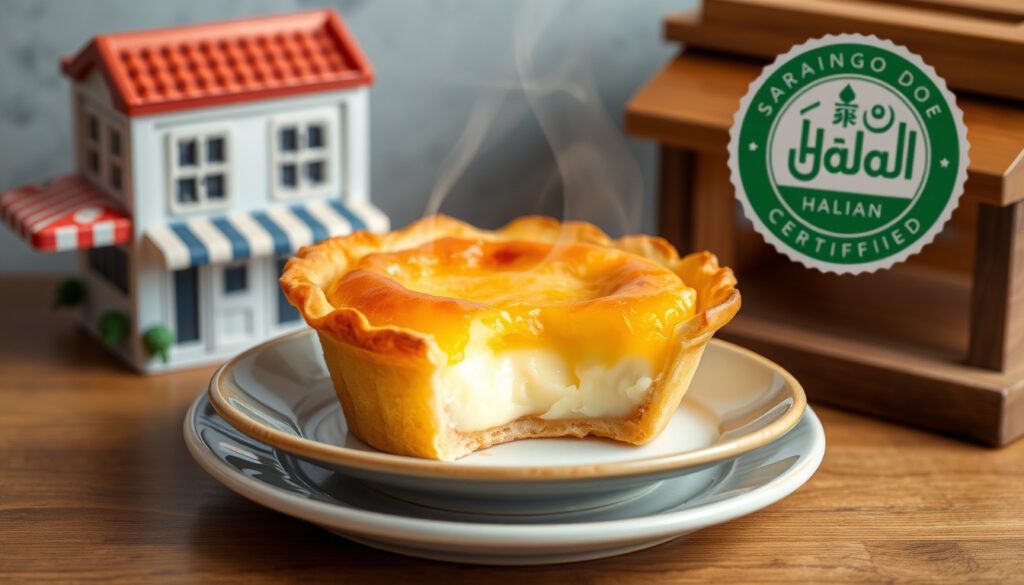
Hokkaido Cheese Tart Singapore: Taste, Halal, How to Eat
Few pastries have sparked as much curiosity in Singapore as the Hokkaido baked cheese tart, a simple crisp shell with a gooey three-cheese filling that has become a genuine food trend. This guide covers everything a first-time buyer needs: taste, halal status, how to eat it, and why Hokkaido dairy makes it special.
Cheese blend: 3 types of high-quality cheeses · Price per piece (Original): S$3.80 · Available flavors: 7 (Original, Chocolate, Durian, Cookies & Cream, Salted Caramel, Sakura Orange Cheese, Egg Brulee) · Halal certified: Yes (per Halaltag listing) · Origin: Hokkaido, Japan · Baked fresh daily: Yes, in-store
Quick snapshot
- Hokkaido baked cheese tart uses a three-cheese blend (Causeway Point store page)
- Original flavor costs S$3.80 per piece (per Halaltag directory) (Causeway Point store page)
- 7 flavors available (per Halaltag directory) (Causeway Point store page)
- Halal certified at Junction 200 outlet (Halaltag listing)
- Exact third cheese type in the blend is not publicly specified (Hokkaido Baked Cheese Tart Australia FAQ)
- Whether all outlets share the same halal certification – only Junction 200 listed on Halaltag (per Halaltag directory) (Hokkaido Baked Cheese Tart Australia FAQ)
- Calorie count per tart – no official nutrition info found (per Halaltag listing) (Hokkaido Baked Cheese Tart Australia FAQ)
- Original price and available flavors come from a community directory, not official brand sources (Hokkaido Baked Cheese Tart Australia FAQ)
- Halal certification reported since 2018 (Halal Boleh directory)
- Baked fresh daily in Singapore outlets (per Causeway Point store page) (Halal Boleh directory)
- Growing demand for halal Japanese pastries in Singapore (Visit Singapore Muslim Visitor Guide)
- Potential expansion to more outlet locations (per Halaltag listing) (Visit Singapore Muslim Visitor Guide)
Six key facts about the Hokkaido baked cheese tart, one takeaway: this tart balances premium ingredients with everyday affordability.
| Attribute | Detail |
|---|---|
| Cheese blend | 3 types including cream cheese, mozzarella, and another |
| Price (Original) | S$3.80 per piece |
| Flavors | 7 (Original, Chocolate, Durian, Cookies & Cream, Salted Caramel, Sakura Orange Cheese, Egg Brulee) |
| Halal certified | Yes (Halaltag listing for Junction 200 outlet) |
| Baked fresh daily | Yes |
| Origin | Hokkaido, Japan |
Singaporeans get a premium Japanese pastry at a price point that undercuts many artisanal bakeries, but the halal certification is limited to specific outlets—check before you travel.
What is a Hokkaido baked cheese tart?
Origin and popularity in Singapore
- The Hokkaido baked cheese tart originated in Hokkaido, Japan’s dairy capital, and arrived in Singapore through the BAKE CHEESE TART brand, which operates outlets at Parkway Parade and Junction 200 (per Halaltag directory of outlets).
- It gained a strong following in Singapore thanks to its distinctive gooey texture and the halo effect of Hokkaido dairy (per Visit Singapore guide on Japanese halal cuisine).
Key ingredients and baking process
- The pastry is made with a blend of three high-quality cheeses: cream cheese, mozzarella, and a third cheese that remains undisclosed (per Causeway Point store description).
- The shell is baked fresh daily in-store, ensuring a buttery crisp exterior and a molten centre (per Causeway Point store page).
Where to find it (outlets in Singapore)
- Multiple outlets across Singapore: Bugis Junction, Causeway Point, Changi Airport T3, Junction 8, Jurong Point, and Parkway Parade (per Halaltag outlet list).
- Delivery available via Foodpanda (per Halaltag listing).
Bottom line: Hokkaido baked cheese tart gives Singapore shoppers a freshly baked Japanese pastry with a three-cheese blend, but outlet availability and delivery options vary—call ahead before visiting.
What this means: The tart’s limited outlet footprint and daily baking mean freshness is high, but availability can be inconsistent—call ahead if you’re making a special trip.
Is Hokkaido cheese tart Singapore halal?
Halal certification status
- The Junction 200 outlet is listed on Halaltag as halal-certified. A separate directory, Halal Boleh, reports the tart has been halal-certified since 2018.
- In Australia, the brand states its tarts are not halal certified but are pork-free and suitable for vegetarians (per Hokkaido Baked Cheese Tart Australia FAQ).
Ingredients check for Muslim consumers
- The Australian FAQ confirms the tarts contain no gelatine, no animal rennets, and are produced in a pork-free facility (per Australia FAQ).
- In Singapore, the brand uses halal-compliant cheeses (enzyme-sourced from microbial or vegetable rennet), but official MUIS certification is not confirmed for all outlets (per Visit Singapore Muslim Visitor Guide).
Official halal tag listing
- Only the Junction 200 outlet is listed on Halaltag; other locations may not have the same certification (per Halaltag listing).
- Muslim consumers can confirm by checking the Halaltag database or asking the outlet directly about separate utensils and preparation areas.
The pattern: Halal certification is not uniform across all BAKE CHEESE TART outlets. The Junction 200 branch is the only confirmed halal option, a critical detail for Muslim diners.
For Singapore’s Muslim community, the gap between one certified outlet and six uncertified ones means you cannot assume a tart from a different location is halal—always verify before buying.
What does Hokkaido cheese tart taste like?
Texture and flavor profile
- Described as creamy, gooey, and rich, with a balance of savory and slightly sweet notes. The three-cheese blend delivers a complex flavour: mild tanginess from cream cheese, stretch from mozzarella, and umami from the third cheese (per Causeway Point store page).
- The shell is buttery and crisp, contrasting with the soft filling. Yelp reviewers mention a “melt-in-the-mouth” consistency when served warm (per Causeway Point store page).
Comparison to regular cheese tarts
- Regular cheese tarts often use a single cheese and have a firmer, more cake-like filling. Hokkaido cheese tarts are distinctly gooier and more savoury due to the blended cheese formula (per Hokkaido Baked Cheese Tart Australia FAQ).
- The Aussie FAQ says the tart “tastes best right out of the oven” but also “awesome when chilled”, offering two distinct experiences (per Causeway Point store page).
Customer reviews from Yelp and Instagram
- Instagram posts highlight the “perfectly baked” golden surface and the oozing filling when cut open (per Halaltag listing).
- Yelp commenters praise the “melt-in-the-mouth” texture, especially when eaten fresh from the oven (per Causeway Point store page).
The takeaway: The Hokkaido cheese tart is not just another cheese tart—it’s a distinct product defined by its three-cheese blend, dual temperature personality, and the Hokkaido dairy reputation that precedes it.
How to eat Hokkaido cheese tart?
Best serving temperature
- Warm is the recommended way: straight from the oven or reheated briefly in a toaster oven or microwave (per Causeway Point store page).
- Cold is also enjoyable: the filling firms up like cheesecake, offering a denser texture (per Causeway Point store page).
Step-by-step eating guide
- Purchase the tart fresh from an outlet or order via delivery.
- If eating later, refrigerate for up to 3 days (per Causeway Point store page).
- To reheat, place in a toaster oven at 150°C for 5 minutes (microwave on low for 15 seconds also works).
- Bite into the tart while the filling is still warm and gooey, or cut into quarters for a cleaner presentation.
- Avoid freezing, as it alters the texture of the filling and shell.
Storage and reheating tips
- Store in the refrigerator for up to 3 days (per Causeway Point store page).
- Reheat at 150°C for 5 minutes to restore gooeyness. Freezing is not recommended (per Hokkaido Baked Cheese Tart Australia FAQ).
The trade-off: Eating warm delivers the full gooey experience, but the cold version is a portable, firmer alternative—choose based on whether you want the signature ooze or a cheesecake-like bite.
What makes Hokkaido cheese special?
Hokkaido’s dairy farming traditions
- Hokkaido is Japan’s dairy capital, known for its cool climate, clean air, and rich pastures (per Visit Singapore guide).
- The region’s milk has high butterfat content, producing exceptionally creamy cheese (per Hokkaido Baked Cheese Tart Australia FAQ).
Why Hokkaido milk and cheese are prized
- Hokkaido dairy products like cheese, butter, and ice cream are sought after for their rich flavour and smooth texture.
- The cool climate allows cows to produce milk with a high concentration of milk solids, translating to richer cheese (per Visit Singapore guide).
How this translates to cheese tarts
- The tart uses Hokkaido cream cheese blended with other premium cheeses to achieve a unique taste that can’t be replicated with generic imported cheeses (per Causeway Point store page).
- The secret recipe combines locally sourced Hokkaido cheese with mozzarella and a third cheese, creating the signature gooey yet tangy filling.
Why this matters: The Hokkaido cheese tart’s appeal isn’t just marketing—it’s built on a genuine dairy advantage that gives the filling a creaminess standard cheese tarts can’t match.
Specifications at a glance
Seven specifications reveal two extremes: wide flavour variety and limited public nutritional data.
| Specification | Detail |
|---|---|
| Cheese blend | 3 types (cream cheese, mozzarella, undisclosed third) |
| Price (Original) | S$3.80 per piece (per Halaltag) |
| Available flavors | 7 (Original, Chocolate, Durian, Cookies & Cream, Salted Caramel, Sakura Orange Cheese, Egg Brulee) |
| Halal certification | Yes – Junction 200 outlet only (per Halaltag) |
| Baked fresh | Daily in-store (per Causeway Point) |
| Vegetarian suitability | Yes – no gelatine, no animal rennets (per Australia FAQ) |
| Delivery | Available via Foodpanda (per Halaltag) |
Clarity report
Confirmed facts
- Hokkaido Baked Cheese Tart is available in Singapore at BAKE CHEESE TART outlets.
- It uses a three-cheese blend.
- It is halal certified at the Junction 200 outlet per Halaltag.
What’s unclear
- Exact third cheese type used in the blend is not publicly specified.
- Whether all outlets have the same halal certification – only Junction 200 listed.
- Calorie count per tart – no official nutrition info found.
- Original price and available flavors are from a community directory, not official brand sources.
What others are saying
“The tart tastes best when it is right out of the oven. It also tastes awesome when chilled.”
– Causeway Point store description (per Causeway Point store page)
“Our tarts and soft serve are not halal certified in Australia. They are pork free and produced in a pork-free facility.”
– Hokkaido Baked Cheese Tart Australia FAQ (per Australia FAQ)
For Singapore food lovers, the decision comes down to a single question: which outlet are you near? If it’s Junction 200, you get a halal-certified, freshly baked tart with seven flavour options. If it’s any other location, you’ll need to verify halal status on the spot. The Hokkaido cheese tart is undeniably delicious, but its fragmented certification means no two outlets offer exactly the same guarantee.
Frequently asked questions
Can I eat Hokkaido cheese tart if I am lactose intolerant?
Because the tart contains three types of cheese including mozzarella and cream cheese, it contains lactose. Those with severe intolerance may react, but small portions are sometimes tolerated. Check with the outlet for ingredient specifics.
How long does a Hokkaido cheese tart stay fresh?
Refrigerated, it stays fresh for up to 3 days. Reheat at 150°C for 5 minutes to restore texture. Freezing is not recommended (per Causeway Point store page).
Is Hokkaido cheese tart suitable for children?
Yes. The tart contains dairy and eggs but no alcohol-based ingredients. It is suitable for children, though those with dairy allergies should avoid it (per Hokkaido Baked Cheese Tart Australia FAQ).
Do they offer vegan versions?
No. The product is dairy-based and contains eggs. Vegan alternatives are not currently available (per Australia FAQ).
Can I order Hokkaido cheese tart in bulk for events?
Yes, corporate or event orders can be placed through selected outlets. Contact the store directly or check delivery platforms like Foodpanda for bulk pricing (per Halaltag listing).
Is there a difference between Hokkaido cheese tart and regular cheese tart?
Yes. The Hokkaido version uses a three-cheese blend (including Hokkaido cream cheese), has a gooier texture, and a buttery shortcrust shell. Regular cheese tarts typically use a single cheese and have a firmer filling (per Causeway Point store page).
What is the best time to eat Hokkaido cheese tart?
The tart is best enjoyed fresh out of the oven when the filling is warm and gooey. It is also tasty chilled as a firmer, cheesecake-like dessert (per Causeway Point store page).
Related reading
- Tong Heng Egg Tart: What Makes It a Singapore Icon – another iconic tart from a local bakery.
- Clementi Mall Halal Food: Eateries, New Food Court & More – a guide to halal dining in a Singapore mall with similar certification concerns.
More related posts
 Sanfrecce vs Johor Darul Ta’zim: Match Recap 2026
 Where to Go in Osaka: Neighborhoods, Attractions & Itinerary
 1500 SGD to INR: Live Rates, Converter & Salary Guide
 You Are My Hero Review: Worth Watching? Story & Song
 Singapore Grand Prix Senior Manager Job: Salary & Career Guide
 Medusa Italian Osteria Romana Menu: Prices & Roman Pasta
 Wells Water Dispenser Price: Models, Costs & Buying Guide
 Jung So-min Movies and TV Shows: Full List 2024-2025