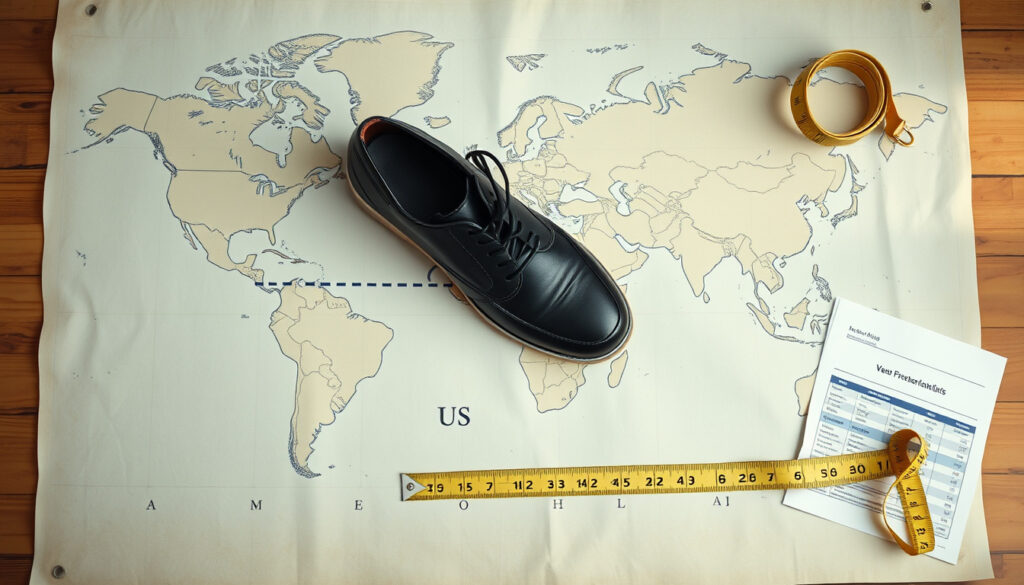
US to EU Shoe Size Conversion: Charts & Guide
Anyone who has ever stared at a European shoe size chart while holding a US-made sneaker knows the feeling: it should be simple, but somehow it isn’t. A US women’s 8 might be a European 38, a 39, or something in between, depending on the brand, the style, and even the country where the shoe was designed.
Women’s US 8 to EU: 38 or 39 depending on brand · Men’s US 8 to EU: 41 · Kids’ US 8 to EU: approx. 25 · Women’s formula: US + 31 ≈ EU · Men’s formula: US + 33 ≈ EU
Quick snapshot
- Women’s US 8 maps to EU 38 or 39 (Famous Footwear size chart)
- Men’s US 8 maps to EU 41 (Finish Line sizing guide)
- Kids’ US 8 maps to EU 25 (New Balance kids guide)
- Exact Onitsuka Tiger conversion varies by model (Kohl’s brand variation warning)
- Rarest foot shape debated among experts (Kohl’s brand variation warning)
- Foot size as height predictor lacks scientific consensus (Kohl’s brand variation warning)
- Feet may widen over time due to ligament relaxation (Kohl’s brand variation warning)
- Boys’ feet grow fastest ages 1–3, then slow until puberty
- Feet typically stop growing around age 20 for males
- Feet may widen over time due to ligament relaxation
- Measure foot length heel-to-toe before every purchase (Nike measurement guide)
- Check brand-specific charts — generic conversion won’t guarantee fit (Nike measurement guide)
- Consider width and foot shape, not just length (Nike measurement guide)
The following table provides a quick reference for key conversions.
| Label | Value |
|---|---|
| Women’s US 8 EU size | 38 or 39 (brand dependent) |
| Men’s US 8 EU size | 41 |
| Kids’ US 8 EU size | 25 |
| Conversion formula women | US + 31 ≈ EU |
| Conversion formula men | US + 33 ≈ EU |
| Onitsuka Tiger recommendation | Half size up from usual US size |
Is a US size 8 a 38 or 39?
The short answer: it depends on whether you’re shopping for women’s, men’s, or kids’ shoes — and which brand you pick. A US women’s size 8 typically falls between EU 38 and EU 39, while a US men’s size 8 lands at EU 41. The reason lies in how each sizing system measures the foot.
What is the difference between EU 38 and 39?
- EU 38 corresponds to a foot length of roughly 24 cm (9.5 inches). Shoe Carnival’s size chart places US 9.5 at EU 40 with a 10-inch foot length, so EU 38 sits about a half-inch shorter.
- EU 39 corresponds to roughly 24.7 cm (9.7 inches) — a difference of about 0.7 cm, or the width of a pinky nail.
- The European sizing system uses the Paris point: one full EU size equals 2/3 cm of foot length, according to Grivet Outdoors’ explanation of continental sizing.
- Some brands assign US women’s 8 to EU 38, others to EU 39, and a few split the difference at 38.5.
The implication: if you normally wear a US women’s 8, you may need to try both EU 38 and 39 the first time you order from a new brand. The difference is small but can be enough to cause slipping or pinching.
How to convert men’s US sizes to EU
Men’s conversion follows a different baseline. According to Finish Line’s sizing chart, US men’s 9 equals EU 42 and US men’s 10 equals EU 43, which makes US men’s 8 equal to EU 41. Famous Footwear’s men’s chart confirms the pattern, mapping US men’s 9 to EU 43 — a one-size discrepancy that highlights brand variation even within men’s sizing.
What this means: the rough formula for men’s conversion is US size + 33 ≈ EU size, but this is an approximation. Always check the brand’s own chart.
Women’s US to EU size conversion
Women’s conversion is more variable. Famous Footwear’s women’s chart maps US 8 to EU 39 and US 9 to EU 40, while Veronica Beard’s women’s guide maps US 7.5 to EU 38 and US 8 to EU 38.5. Flow Feet’s chart uses ranges: US 8 maps to EU 38–39, reflecting real-world overlap.
- The common formula for women: US size + 31 ≈ EU size.
- EU 38 is frequently listed as US women’s 7.5, and EU 39 as US women’s 8.5.
- For US women’s 8, expect EU 38, 38.5, or 39 depending on the brand.
A US women’s 8 can land on three different EU numbers. The only way to be sure is to measure your foot length in centimeters and compare it directly to the brand’s size chart — not the generic one you find on Google.
What size to get in Onitsuka Tiger?
Onitsuka Tiger, the Japanese brand behind the iconic Mexico 66 and Tokuten silhouettes, has a devoted following — but its sizing can trip up first-time buyers. The brand’s shoes are built on a last that differs from standard US sizing, so relying on your usual number is risky.
Do Onitsuka Mexico 66 run big or small?
- Onitsuka Tiger shoes typically run small compared to standard US sizes, per the brand’s own size guidance and customer feedback.
- The Mexico 66, Onitsuka’s most famous model, often requires going half a size up from your usual US size.
- Kohl’s shoe size guide emphasizes that sizing varies by brand, which is especially true for Japanese labels that follow a different foot shape standard.
- If you normally wear a US women’s 8 in Nike or Adidas, start with an EU 39 in Onitsuka Mexico 66 rather than EU 38.
Should I size up or down Onitsuka Tokuten?
The Onitsuka Tokuten runs closer to true to size but has a narrower fit. Nordstrom’s Nike conversion chart illustrates how brand-specific sizing works: women’s 5 maps to men’s 3.5 and kids’ 3.5Y, showing that even within a single company, conversions require care. For Tokuten, buyers with wider feet may want to size up half a step for comfort.
Onitsuka Tiger size chart comparison
Eight brands, one pattern: no two charts agree perfectly. Finish Line and Famous Footwear offer different mappings for the same US sizes, and Veronica Beard uses half-step EU numbers that mainstream athletic brands skip. Onitsuka’s own charts should always be your final reference.
How quickly do boys’ feet grow?
If you’re a parent buying shoes for a growing boy, you know the rhythm: just when you find a pair that fits, he outgrows it. Understanding the pace of foot growth can save money and prevent ill-fitting shoes.
At what age do feet stop growing?
- Boys’ feet grow fastest between ages 1 and 3, averaging 1 to 2 sizes per year, according to podiatric growth data.
- Growth slows between ages 4 and 10, then accelerates again during puberty (roughly ages 12–15 for boys).
- Feet typically stop growing around age 20 for males, though some may see subtle changes into their early 20s.
- New Balance’s kids size guide organizes its chart by foot length rather than age, which is more accurate because growth rates vary widely.
Will my son be tall if he has big feet?
This is one of the most common questions parents ask, and the answer is more nuanced than folklore suggests. While there is a statistical correlation between foot length and height — taller people tend to have larger feet — foot size is not a reliable predictor of adult height. Growth plates in the feet close before growth plates in the long bones of the legs, so large feet in childhood don’t guarantee tall stature later. No major study has established a formula that predicts height from shoe size with meaningful accuracy.
A child who suddenly jumps two shoe sizes in six months is likely entering a growth spurt that will affect height, too. But the shoe size itself isn’t the crystal ball — it’s the rate of change that matters.
The pattern: growth spurts often lead to rapid shoe size changes, but foot size alone is not a predictor of final height.
Do feet get wider with age?
Many adults notice that shoes they wore in their 20s no longer fit in their 40s. It’s not imagination — feet change shape over time, and width is the most common adjustment.
How to measure foot width
Foot width is measured across the widest part of the foot (the ball, just below the toes). Adidas’s measurement guide provides a benchmark: a US men’s size 9 is about 4.2 inches wide at standard width, and more than 4.4 inches is considered wide. For women, a US size 9 is about 3.8 inches wide at standard, and above 3.9 inches is wide. Nike’s measurement guide recommends tracing your foot on paper while standing — your weight flattens and widens the foot, so sitting measurements will be too narrow.
Best shoe styles for wide feet
- Look for brands that offer explicit wide (W) and extra-wide (XW) sizing in both US and EU scales.
- Athletic brands like New Balance and Adidas have dedicated wide lines; New Balance’s size guide includes separate width columns.
- Avoid pointed-toe styles — they compress the toes and worsen width issues over time.
- Shoes with removable insoles let you swap in a thinner insert if you need a few extra millimeters of width.
The pattern: feet widen gradually as ligaments relax and the arch flattens. Kohl’s advice to measure both feet every time you shop is especially important for adults over 40.
Which foot shape is the rarest?
Foot shape influences which shoes feel comfortable and which cause blisters, yet most shoppers never think about it. There are four main foot shapes, and one of them is much less common than the others.
What are the different foot shapes?
- Egyptian foot: The big toe is the longest, and the other toes taper at a downward angle. This is the most common foot shape, found in roughly 50–60% of the population.
- Greek foot: The second toe is longer than the big toe. This shape is associated with a higher arch and is more common among people of Mediterranean ancestry.
- Roman foot: The first three toes are roughly the same length, with the others shorter. This square-shaped foot is more common in people with broader frames.
- Celtic foot: All five toes are nearly the same length, giving the foot a very square appearance. This is the rarest foot shape.
How foot shape affects shoe fit
Your foot shape determines which last (the mold a shoe is built on) will fit you best. Egyptian feet typically fit well in most shoes because the tapered toe mirrors the shape of a standard last. Greek feet may find pointed-toe shoes uncomfortable because the longer second toe presses against the tip. Roman and Celtic feet benefit from shoes with a square or rounded toe box that accommodates the even toe length. Kohl’s guide notes that sizing varies by brand, and the same advice applies to shape: a brand that uses a Greek-inspired last may never feel right on a Celtic foot.
If you’ve ever wondered why a certain brand always gives you blisters on your pinky toe, your foot shape is probably the culprit. Match the shoe’s last to your foot shape, not just the size number.
Brand-by-brand conversion comparison
Five brands, five different takes on what a US women’s 8 means in EU sizing. The table below shows how much the numbers can shift.
| Brand | US Women’s 8 → EU | US Men’s 9 → EU | Source |
|---|---|---|---|
| Famous Footwear | 39 | 43 | Famous Footwear |
| Finish Line | — | 42 | Finish Line |
| Veronica Beard | 38.5 | — | Veronica Beard |
| Flow Feet | 38–39 (range) | — | Flow Feet |
| Grivet Outdoors | 38.5 | 42 | Grivet Outdoors |
The pattern: a US women’s 8 can be EU 38, 38.5, 39, or even a range. A US men’s 9 can be EU 42 or 43. Relying on any single chart is a gamble — cross-reference at least two sources.
Foot length to EU size mapping
Six sizes, one rule: foot length in centimeters is the only consistent baseline across brands and countries.
| Foot length (inches) | Foot length (cm) | US women’s | US men’s | EU size | Source |
|---|---|---|---|---|---|
| 9.5 | 24.1 | 7.5 | 6 | 38 | Shoe Carnival |
| 9.7 | 24.6 | 8 | 6.5 | 38.5–39 | Veronica Beard |
| 10 | 25.4 | 9 | 7.5 | 40 | Shoe Carnival |
| 10.25 | 26.0 | 10 | 8.5 | 41 | Flow Feet |
| 10.5 | 26.7 | 11 | 9.5 | 42 | Finish Line |
| 10.9 | 27.7 | 12 | 10.5 | 43 | Famous Footwear |
The trade-off: EU sizing is based on a linear centimeter scale, making it more consistent than US sizing, which uses different baselines for men, women, and children. That’s why measuring your foot in centimeters is the most reliable method.
How to measure your foot for the right size
The single most reliable way to determine your shoe size — in any system — is to measure your foot length and width while standing. Here’s how, based on guidance from Nike’s measurement guide and Adidas’s sizing advice.
- Prepare the workspace: Place a piece of paper on a hard floor against a wall. Tape it down so it doesn’t slip.
- Stand on the paper: Place your foot flat on the paper with your heel touching the wall. Stand normally — your weight should be evenly distributed. Don’t sit; standing gives the true length and width.
- Mark the longest toe: Use a pencil held vertically (not angled) to mark the point at the tip of your longest toe. Do this for both feet — one is often slightly larger.
- Measure the length: Measure the distance from the edge of the paper (where the wall was) to your mark. Record the measurement in both inches and centimeters.
- Measure the width: Mark the widest part of your foot (the ball, below the toes) on both sides and measure the distance between the two marks. Compare to Adidas’s width benchmarks: for men, standard width at US 9 is 4.2 inches; for women, standard at US 9 is 3.8 inches.
- Consult a brand-specific chart: Use the brand’s own conversion chart for your foot length in centimeters. New Balance’s kids guide is a good example of how foot-length-based charts work.
Why this matters: a measurement done once, carefully, replaces years of guesswork. Write your centimeter length down and keep it — it’s the one number that translates across every brand and every country.
What we know and what remains unclear
Confirmed facts
- Women’s US 8 = EU 38 or 39 depending on brand (Famous Footwear)
- Men’s US 8 = EU 41 (Finish Line)
- EU sizing uses Paris point: 2/3 cm per size (Grivet Outdoors)
- Conversion formulas are approximate (US women’s + 31, US men’s + 33)
What’s unclear
- Exact Onitsuka Tiger conversion varies by model — brand guidance is the only reliable source
- Rarest foot shape: the Celtic foot is believed rarest, but prevalence data is limited
- Foot size as a predictor of adult height lacks strong scientific consensus
- Whether EU 38 or 39 is “correct” for US women’s 8 depends entirely on the brand’s lasts
- Feet may widen with age due to ligament relaxation – but the extent varies individually
“The most common mistake people make is relying on a generic conversion chart instead of measuring their foot in centimeters. Your foot length doesn’t change when you cross a border — your size label does.”
— Nike, official measurement guide
“A US women’s size 9 is about 3.8 inches wide at standard width. If your measurement is above 3.9 inches, you should look for wide-width options — don’t just size up, because the shoe will be too long.”
— Adidas, sizing blog
“Sizing may vary by brand. Always measure your foot flat on the floor — never while sitting or in a shoe — to get an accurate measurement.”
— Kohl’s, shoe size guide
The takeaway from these three sources: measure your foot in centimeters while standing, check width separately, and never assume a brand’s label matches another’s. The evidence from Nike, Adidas, and Kohl’s converges on the same advice: measure, don’t guess.
For most shoppers, the best strategy is to measure foot length in centimeters and use that as the primary reference across all brands.
Frequently asked questions
How do I convert US men’s to EU shoe size?
Add approximately 33 to the US men’s size. For example, US men’s 8 ≈ EU 41, US men’s 9 ≈ EU 42. However, brand variation exists, so check the specific brand’s chart. Finish Line’s sizing chart is a reliable reference for many athletic brands.
What is the difference between UK and US shoe sizes?
UK sizing is roughly equivalent to US sizing minus 0.5 for men and minus 2 for women, according to Grivet Outdoors. A UK men’s 8 is about a US men’s 8.5, and a UK women’s 6 is about a US women’s 8.
Do European shoe sizes run smaller than US sizes?
EU sizes are based on foot length in centimeters (Paris point), not on the US scale. A numeric EU 38 is not inherently smaller than a US 8 — it’s a different system. The confusion arises because US women’s sizes add about 31 to reach EU, while men’s add about 33, so the same US number maps to different EU numbers for men and women.
How do I measure my foot length for shoe size?
Stand on a piece of paper with your heel against a wall. Mark the tip of your longest toe, measure the distance from the wall to the mark, and record it in centimeters. Use that value on the brand’s size chart. Nike’s guide and Adidas’s guide both recommend this method.
What EU size is a US women’s 7?
A US women’s 7 generally maps to EU 37 or 37.5. Flow Feet’s chart maps US women’s 7 to EU 37–38, and Veronica Beard maps US 7.5 to EU 38, so 37.5 is a common midpoint.
Is there a universal shoe size conversion chart?
No single chart works for all brands. Generic conversion tables (like the formulas US women’s + 31 and US men’s + 33) are useful starting points, but each brand uses its own lasts and may shift sizes by half a step. Always use the brand’s published chart.
Why do some brands fit differently even at the same numeric size?
Each brand designs shoes on a last (a foot-shaped mold) that reflects its target market’s average foot shape. Japanese brands like Onitsuka Tiger use a different last than American brands like Nike. The same EU number can therefore fit differently because the underlying shape differs.
Can I use the same conversion for all types of shoes?
Not reliably. Athletic shoes often have more generous toe boxes and different volume than dress shoes. Boots may require a full size up to accommodate thicker socks. Always measure your foot and consult the brand’s chart for the specific shoe category.
More related posts
 Tiong Bahru Market Renovation 2025: Closure, Reopening Details
 CPF Contribution Rate 2026 for Age 55 and Above: Full Guide
 Najib Razak Verdict Reactions: 1MDB Scandal Conviction Analysis
 Vibe at Ea t Coa t: US & Ireland Life tyle and Town
 Kampong Glam Bazaar 2026: Dates, Hours & Visitor Guide
 1000 MYR to SGD – Live Rate, Historical Trends and Best Transfer Tips
 Vijay Jana Nayagan Audio Launch 2025: Date, Telecast & Highlights
 Sinners (2025 Film) Reviews – 97% Rotten Tomatoes Score