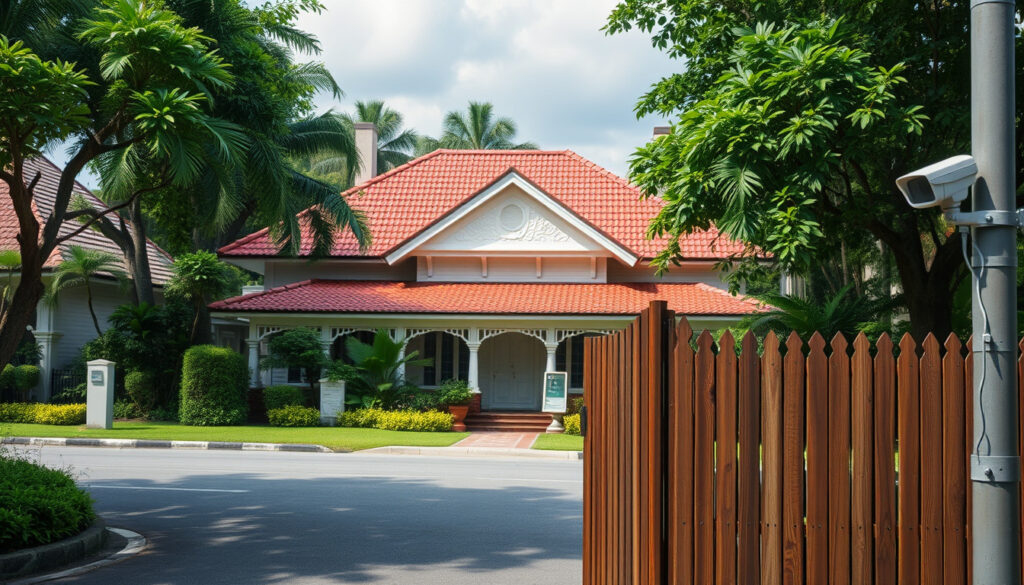
Lee Kuan Yew Bungalow: Location and Family Dispute
Few homes carry the weight of a nation’s history quite like 38 Oxley Road. This unassuming bungalow in Singapore’s Orchard area has become the focus of a bitter family feud over its fate—Lee Kuan Yew himself wanted it demolished, but his children are divided.
Address: 38 Oxley Road · Year built: 1898 · Bedrooms: 8 · Land area: 2,770 sq m · Lee Kuan Yew moved in: 1940s · Current owner (disputed): Lee Hsien Yang
Quick snapshot
- Lee Kuan Yew’s will includes a demolition clause (Business Times)
- Sibling conflict between Lee Hsien Loong and Lee Hsien Yang (The Straits Times)
- Property offered for sale at more than S$100 million (South China Morning Post)
- Wanted house demolished after his death (National Archives of Singapore)
- Cremated; ashes at Mandai Columbarium (Wikipedia)
- Agnostic beliefs (Wikipedia)
- Ownership disputed (The Straits Times)
- Lee Hsien Yang reportedly moved abroad (ABC News)
- No demolition date set (The Straits Times)
Seven key facts, one consistent tension: a beloved leader’s final wish collides with the law and family loyalty.
| Label | Value |
|---|---|
| Address | 38 Oxley Road, Singapore |
| Year built | 1898 |
| Bedrooms | 8 |
| Land area | 2,770 sq m |
| Owner (disputed) | Lee Hsien Yang |
| Demolition wish | Yes, per Lee Kuan Yew’s will |
| Ashes location | Mandai Crematorium and Columbarium |
The table above distills the core facts, but the real story lies in the conflict between a father’s explicit instructions and the legal machinery that now blocks them.
Where is Lee Kuan Yew’s house?
What is the address of the bungalow?
- 38 Oxley Road, Singapore 238629 (Wikipedia)
It sits on a quiet street in the Orchard planning area, a few minutes’ walk from the Istana.
What are the key features of 38 Oxley Road?
- A two-storey, eight-bedroom bungalow built in 1898 (Wikipedia)
- Land area of 2,770 sq m (29,800 sq ft) (Business Times)
- Lee Kuan Yew moved into the house in the 1940s (Wikipedia)
When was the bungalow built?
The property was constructed in 1898, according to historical records (National Archives of Singapore). That makes it one of the older surviving colonial-era houses in the area.
The bungalow’s age and historical association mean any demolition or preservation decision carries weight for Singapore’s built heritage. The government’s heritage agency has already deemed it of national significance (ABC News).
The implication: the property’s colonial-era origins set the stage for a century of history that led directly to the current impasse.
Why does Lee Kuan Yew want his house demolished?
What did Lee Kuan Yew say about demolishing the house?
In his final will dated 17 December 2013, Lee Kuan Yew included a demolition clause that states the house “should be demolished immediately” after his death, or after his daughter Wei Ling moved out if she chose to remain (National Archives of Singapore). He argued that the building should not become a “national shrine” or attract unwanted attention (Reuters).
Is the demolition clause in his will?
Yes. The will explicitly requires demolition “as soon as practicable” and, if demolition becomes legally impossible, that the house never be opened to anyone except his children, their families, and descendants (National Archives of Singapore).
“If demolition is not possible because of changes in laws, rules, or regulations, the house should never be opened to others except my children, their families, and descendants.”
— Lee Kuan Yew, extract from his will (reproduced by Reuters)
Who owns 38 Oxley Road now?
How much did Lee Hsien Yang pay for 38 Oxley Road?
Lee Hsien Yang inherited the property after his father’s death. The house has never been sold in a public transaction, but recent offers have reportedly exceeded S$100 million (South China Morning Post). The exact amount Lee Hsien Yang paid—if any—has not been disclosed because the inheritance was through the estate.
Why is ownership disputed?
The dispute centres on interpretation of the will. Lee Hsien Yang and his sister Lee Wei Ling publicly accused their brother, then-Prime Minister Lee Hsien Loong, of trying to block demolition against their father’s wishes (The Straits Times). Lee Wei Ling also claimed the PM had threatened to gazette the house, which would legally prevent demolition (The Straits Times).
The pattern: a family rift that remains unresolved years later. In 2025, the property was officially declared a national monument by the Singapore government (South China Morning Post), effectively blocking any immediate demolition.
What this means: the gazette order overturns the demolition clause, giving the state final authority over the bungalow’s fate.
Where are Lee Kuan Yew’s ashes kept?
Did Lee Kuan Yew have a religion?
Lee Kuan Yew described himself as an agnostic (Wikipedia). He was cremated after his death in 2015.
Is it legal to scatter ashes in Singapore?
Yes, inland ash scattering is legal with a permit from the National Environment Agency. However, Lee Kuan Yew’s ashes were placed at the Mandai Crematorium and Columbarium, where they remain accessible to the public (Wikipedia).
The implication: his choice of columbarium placement, rather than scattering, reflects a desire for a permanent but modest resting place.
Where does Lee Hsien Yang live now?
Why did Lee Hsien Yang leave Singapore?
Lee Hsien Yang reportedly moved overseas partly because of the family dispute over the bungalow (ABC News). His precise current residence is not publicly confirmed, though some reports suggest he lives in the United Kingdom.
How rich is Lee Hsien Loong?
As a former Prime Minister, Lee Hsien Loong’s personal wealth is not a direct factor in the bungalow dispute. The conflict is primarily over interpretation of their father’s will, not financial interests.
The pattern: the dispute transcends money, rooted instead in family loyalty and the weight of a father’s last command.
The government’s decision to gazette the house as a national monument means Lee Hsien Yang’s application to demolish it will be overridden. For the Lee family, the choice is now between accepting legal preservation or pursuing further legal action.
Timeline signal
- 1898: Bungalow at 38 Oxley Road constructed (National Archives of Singapore)
- 1940s: Lee Kuan Yew moves into the bungalow (Wikipedia)
- 2015: Lee Kuan Yew dies; his will reveals a clause calling for demolition (Business Times)
- 2017: Public dispute among Lee siblings over the house’s fate (The Straits Times)
- 2025: Property reportedly offered for sale for more than S$100 million; government gazettes it as a national monument (South China Morning Post)
Confirmed facts
- Address: 38 Oxley Road (Wikipedia)
- Built in 1898 (Wikipedia)
- 8 bedrooms (Wikipedia)
- Lee Kuan Yew’s will contains a demolition clause (National Archives of Singapore)
- Lee Kuan Yew was cremated and his ashes are at Mandai Columbarium (Wikipedia)
- The house was gazetted as a national monument in 2025 (South China Morning Post)
What’s unclear
- Exact current owner after disputed inheritance
- Whether demolition will actually happen given the gazette order
- Lee Hsien Yang’s precise current residence
- Final sale price if the house is ever sold
Voices from the Lee family
“I have always held the view that the house should be torn down. It should not become a national shrine.”
— Lee Kuan Yew, as expressed in his will (via Reuters)
“This is a deeply painful matter for our family. We have done our best to honour our father’s wishes.”
— Lee Hsien Yang, quoted by South China Morning Post (2025)
The Lee family dispute over 38 Oxley Road is far from over. With the government now in control of the building’s fate, Lee Hsien Yang faces a clear choice: accept preservation or challenge the gazette in court. For Singaporeans, the bungalow remains a symbol of the difficulty in reconciling personal wishes with national heritage.
onecms-res.cloudinary.com, straitstimes.com, straitstimes.com, mothership.sg
Frequently asked questions
How much did Lee Hsien Yang pay for 38 Oxley Road?
Lee Hsien Yang inherited the property through his father’s estate. No public sale price has been recorded, though offers have exceeded S$100 million.
Did Lee Kuan Yew have a religion?
He described himself as agnostic (Wikipedia).
Is it legal to scatter ashes in Singapore?
Yes, with a permit from the National Environment Agency.
What is the significance of the bungalow at 38 Oxley Road?
It was Lee Kuan Yew’s home for decades and is now a national monument.
Has the bungalow at 38 Oxley Road been sold?
No. Ownership is still disputed, and the property has been gazetted.
Where is Lee Kuan Yew’s house located?
38 Oxley Road, Singapore 238629.
Why did the government gazette the house?
A heritage advisory body found it of national significance (ABC News).
Related reading
More related posts
 சோதிடம் – Vedic Roots and Historical Principles
 Why Crypto Down Today – ETF Outflows, Fed Impact, Recovery Outlook
 Virtual Assistant Jobs Singapore: Salary, Requirements & Tips
 Search Google or Type a URL: What It Means and How to Use It
 S&CC Rebate 2026: Eligibility, Amount and Dates
 Novotel Bangkok Platinum Pratunam: 4-Star Hotel Review
 Star Vista Halal Food: 10+ Restaurants & Food Court Guide
 Ghost of Yotei Hot Springs – All 16 Locations Guide