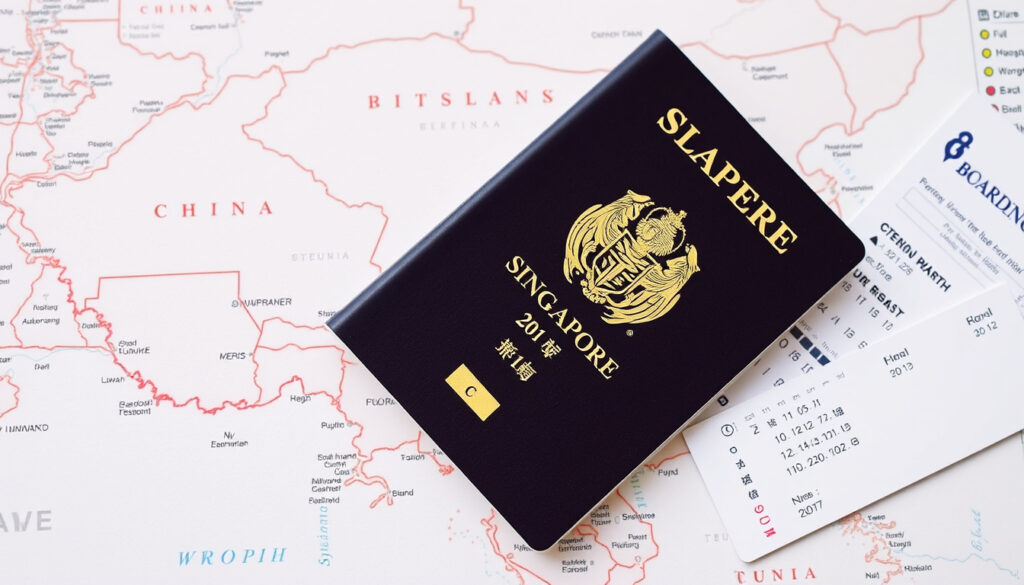
Do Singaporeans Need a Visa to China? 30-Day Exemption
Since February 2024, Singaporeans with ordinary passports can enter China visa-free for up to 30 days — but a visa is still needed for longer stays or for work and study. Here’s what you need to know before you go.
Visa-free stay duration: 30 days ·
Effective date of exemption: 9 February 2024 ·
Passport requirement: Ordinary Singapore passport ·
Purpose allowed without visa: Tourism, business, family visit, transit ·
Maximum stay with visa: Up to 90 days (if required)
Quick snapshot
- Visa-free for up to 30 days (Immigration & Checkpoints Authority of Singapore (official government))
- Effective 9 February 2024 (Trip.com Singapore (travel booking platform))
- Ordinary passport only (Chinese Visa Application Service Center (Singapore) FAQ)
- Valid passport (Chinese Visa Application Service Center (Sydney) FAQ)
- Completed arrival card (Health Declaration) (Trip.com Singapore) (Chinese Visa Application Service Center (Sydney) FAQ)
- Return/onward ticket (Wise Singapore (financial travel guide))
- Apply for tourist visa (L) before travel (China Discovery (travel guide))
- Maximum 90 days (China Discovery) (China Discovery (travel guide))
- Proof of accommodation and funds required (Trip.com Singapore) (China Discovery (travel guide))
- Transit without visa not needed – already covered (CVASC FAQ)
- 144-hour rule does not apply (less generous) (CVASC FAQ)
- Work/study require separate visa categories (China Discovery)
Five facts about Singapore’s visa-free access to China, one pattern: the policy is generous for short trips but strictly limited in duration and purpose.
| Fact | Detail | Source |
|---|---|---|
| Visa-free countries to China | Singapore is among ~20 countries with unilateral visa-free access | ICA Singapore |
| Start date of policy | 9 February 2024 | ICA Singapore |
| Maximum consecutive days | 30 days | ICA Singapore |
| Entry purposes allowed | Tourism, business, family visit, transit | CVASC FAQ |
| Official confirmation | Singapore MFA and Chinese visa center (visaforchina.cn) | CVASC FAQ |
Do Singaporeans need a visa to China now?
Current visa exemption rule
- Singapore ordinary passport holders are exempt from visa requirements for stays up to 30 days (ICA Singapore).
- Visa-free entry covers tourism, business, family visits, and transit (CVASC FAQ).
- For stays longer than 30 days or non-covered purposes, a visa is required (ICA Singapore).
Effective date and official source
- The mutual 30-day visa exemption took effect on 9 February 2024 (ICA Singapore).
- It applies exclusively to ordinary passport holders of Singapore and China (ICA Singapore).
Singaporeans enjoy a straightforward visa-free policy for short trips — no application, no fee, no transit trick needed. The catch: it’s strictly 30 days, and you need an ordinary passport.
The implication: for a typical holiday or business trip under a month, you can skip the embassy entirely. But the moment your plans exceed 30 days or involve work, you’re back in visa territory.
How long can Singaporeans go to China?
30-day visa-free maximum
- The visa-free maximum stay is 30 consecutive days (ICA Singapore).
- Extensions are not available under the visa-free policy; a visa is needed for longer stays (China Discovery).
- With a visa, stays can be up to 90 days (e.g., L visa for tourism) (Trip.com Singapore).
Extensions and longer stays
- If you need to stay longer than 30 days, you must apply for a visa before departure (CVASC FAQ).
- No in-country extension is permitted under the exemption (Wise Singapore).
Overstaying the 30-day limit risks fines and entry bans. The policy is clear: no extensions, no exceptions — plan your exit or get a visa.
The trade-off: the 30-day exemption is generous for quick trips, but travellers planning extended visits must navigate the visa process. For longer stays, the visa route is the only legal path.
Do Singaporeans need to fill in a China arrival card?
Arrival card (Health Declaration)
- All travelers entering China must complete a Health Declaration form (customs) – usually electronic via the 12367 APP or WeChat (Trip.com Singapore).
- The paper arrival card may still be distributed on flights; digital completion is preferred (China Discovery).
- Failure to complete may delay entry (Wise Singapore).
12367 APP guide
- Download the 12367 APP or use the WeChat mini-program to fill out the Health Declaration before arrival (CVASC FAQ).
- You’ll need your passport details, flight information, and address in China.
Skipping the Health Declaration can turn a smooth arrival into a queue at immigration. A two-minute digital form saves time and avoids confusion.
What this means: the arrival card is a minor but mandatory step. Do it on your phone before landing, and you’ll breeze through customs.
What is the 144 hour rule in China?
What it is
- The 144-hour visa-free transit rule allows nationals of certain countries to stay in designated cities for up to 144 hours (CVASC FAQ).
- It applies only to transiting passengers who have a confirmed onward ticket to a third country.
Why it does not apply to Singaporeans
- Singaporeans already have 30-day full visa-free access, so the 144-hour rule is irrelevant and less generous (ICA Singapore).
- The list of eligible nationalities for 144-hour transit does not include Singapore (not needed) (China Discovery).
The pattern: Singaporeans get a better deal – a full 30-day exemption without transit restrictions. The 144-hour rule is for other travellers, not for you.
How to apply for a China visa from Singapore?
When a visa is needed
- Visa required for stays >30 days, work, study, or journalism (China Discovery).
- Also required for family reunion exceeding 30 days (Trip.com Singapore).
Step-by-step application process
- Apply online through the Chinese Visa Application Service Center (CVASC) in Singapore (CVASC FAQ).
- Documents: passport with at least 6 months validity, completed application form, photo, itinerary, etc. (Trip.com Singapore).
- Processing time: typically 4–5 working days; fees vary (Wise Singapore).
- Appointment required for biometrics (CVASC FAQ).
Required documents
- Ordinary passport with at least 6 months validity and 2 blank visa pages (CVASC Sydney FAQ).
- Completed visa application form (CVASC Singapore FAQ).
- Recent passport photo.
- Proof of travel: flight booking, hotel reservation, visa letter if needed.
- For work/study: additional invitation letter and approval.
Even though most Singaporeans don’t need a visa for short trips, the application process for longer stays isn’t complicated — but it does require planning. Start at least two weeks before your intended departure.
What this means: if your trip spills past 30 days, the visa process is straightforward but non-negotiable. Don’t assume you can extend at the border.
Timeline signal
- 9 February 2024 – China introduces unilateral visa-free travel for Singapore ordinary passport holders up to 30 days (ICA Singapore).
- 2025 – Policy remains in effect; no announced changes.
- 2026 – Current status as of 2026: still visa-free for 30 days. (Check official sources for updates.) (CVASC FAQ).
Clarity check
Confirmed facts
- Singapore ordinary passport holders do not need a visa for stays up to 30 days for tourism, business, or family visit (ICA Singapore).
- The policy started on 9 February 2024 and continues as of 2026 (CVASC FAQ).
- Singaporeans are not subject to the 144-hour transit rule because they have a more favorable 30-day exemption (China Discovery).
What’s unclear
- Whether the policy will be extended beyond 2026 – no official announcement yet.
- Exact digital arrival card requirements may change; always check the 12367 APP for latest version.
What officials and experts say
The mutual 30-day visa exemption arrangement between Singapore and the People’s Republic of China took effect on 9 February 2024. Ordinary passport holders do not require a visa for stays of up to 30 days.
— Immigration & Checkpoints Authority of Singapore (official government statement, source)
Singapore citizens who hold ordinary passports may enter China visa-free for up to 30 days for business, tourism, family visits, exchange visits, and transit.
— Chinese Visa Application Service Center (Singapore) FAQ, source
For longer stays or non-tourist purposes, a visa is required. The 30-day waiver is generous but comes with strict limits.
— Trip.com Singapore travel guide, source
For Singaporeans packing for a short trip to China, the visa question is settled: no visa needed as long as you stay 30 days or less. For anyone planning a longer visit, a work assignment, or study, the visa process is the only option. The implication is clear: know your dates and purpose before you book. For the traveller who wants simplicity, the visa-free window is generous; for those who need more, the embassy route is straightforward but requires advance planning.
Frequently asked questions
Do Singaporeans need a visa to transit through China?
No, because Singaporeans already have 30-day visa-free access covering transit. The 144-hour transit rule does not apply to you.
Can I extend my 30-day visa-free stay in China?
No, extensions are not available under the visa-free policy. To stay longer you must apply for a visa before travel.
What documents are needed at immigration for Singaporeans?
You need a valid ordinary passport, a completed Health Declaration (electronic preferred), and a return or onward ticket.
Is the visa-free policy the same for all Singapore passport types?
No, it applies only to ordinary passports. Diplomatic, official, and service passport holders may have different rules.
Do children with Singapore passports need a visa?
No, children holding ordinary Singapore passports are covered by the same visa-free policy for up to 30 days.
What happens if I overstay the 30-day limit?
Overstaying can result in fines, detention, or a ban on re-entry. Always comply with the stay limit or obtain a visa.
Are there any new rules for Singaporeans entering China in 2026?
As of 2026, the 30-day visa-free policy remains in effect. No major changes have been announced. Always verify with official sources before travel.
More related posts
 18K Gold Price in Iran Today: 180,632,000 IRR per gram
 Tiong Bahru Market Renovation 2025: Closure, Reopening Details
 CapitaLand REIT Share Price: Is It a Good Buy? (2026)
 Prayer Times Singapore Today: Official MUIS 2026 Timetable
 Best Linux Distros for Beginners 2025: Expert-Picked Guide
 Warm Up Cafe @ The Star Vista Menu – Prices, Hours, Full Guide
 Wells Water Dispenser Price: Models, Costs & Buying Guide
 Choi Min-ho Biography: SHINee, Dramas, Physical 100