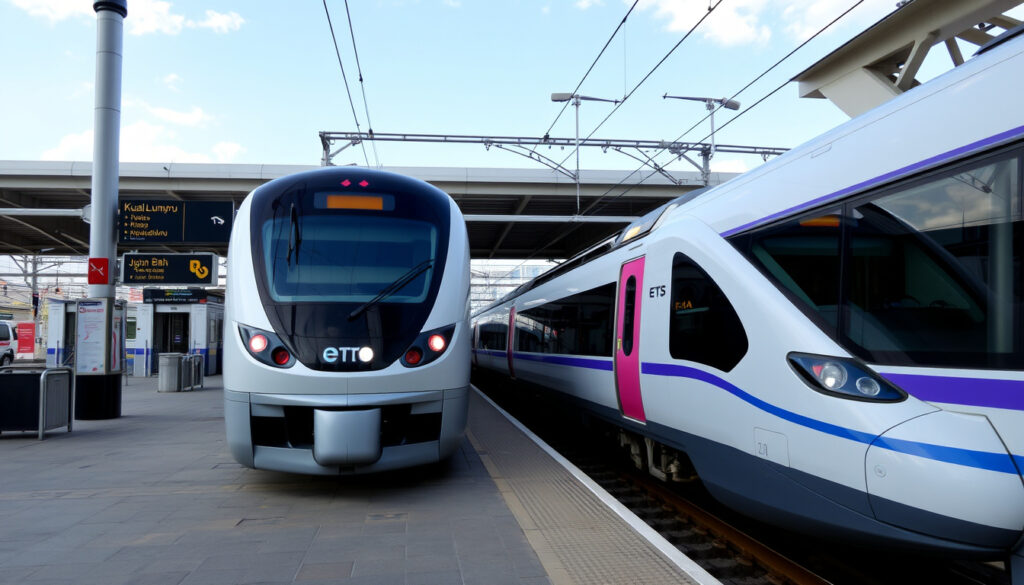
ETS KL to JB 2026: Schedule, Fares & Complete Travel Guide
There’s a moment, when you’re staring at the KL traffic on the North-South Expressway, that you wonder if there’s a smarter way to get to Johor Bahru. The ETS train from KL Sentral to JB Sentral is that alternative—a rail service that promises to trade the steering wheel for a seat and a book.
Distance: 350 km ·
Travel time range: 3.5–4 hours ·
Price range (Standard): RM73–RM109 ·
Daily departures: 5–7 trains ·
Operator: KTMB (Keretapi Tanah Melayu) ·
Main stations: KL Sentral ↔ JB Sentral
Quick snapshot
- Gold: ~4 hours (MyRumahBaru travel guide)
- Platinum: ~3.5 hours (MyRumahBaru travel guide)
- Gold Standard: RM73–RM81 (Wahdah travel portal)
- Platinum Standard: RM96–RM109 (Wahdah travel portal)
- Gold: Standard Class only, 2-2 seating (Wahdah travel portal)
- Platinum: Standard & Business Class, newer trains (Wahdah travel portal)
- Book online at ktmb.com.my (MyRumahBaru travel guide)
- Advance booking opens 30 days ahead (MyRumahBaru travel guide)
- 30% discount on Mon–Thu travel (15 Apr–14 Oct 2026) (MyRumahBaru travel guide)
| Item | Details |
|---|---|
| Distance | 350 km |
| Average Travel Time | 3.5–4 hours |
| First Train | 5:30 AM |
| Last Train | 10:00 PM |
| Operator | KTMB |
| Route | KL Sentral – JB Sentral |
| Number of Stops | 5–7 depending on service |
These figures reflect the pattern: ETS serves KL–JB faster than any road alternative.
How long is the ETS from KL to JB?
The journey from KL Sentral to JB Sentral covers roughly 350 km of track. But the time you spend seated depends on which service you pick.
Typical travel time by ETS Gold vs Platinum
- ETS Platinum: Approximately 3.5 hours — the fastest rail option on this route, with fewer stops (MyRumahBaru travel guide).
- ETS Gold: Around 4 hours — makes additional stops at stations like Gemas, Segamat, Kluang, and Kulai (Wahdah travel portal).
Factors that affect travel duration
- Number of intermediate stops: Gold trains call at 5–7 stations; Platinum trains stop at fewer than 5 (Wahdah travel portal).
- Track conditions and scheduled maintenance can add 5–15 minutes — though KTMB generally runs within published schedules.
Comparison with driving or bus
- Driving: 4–5 hours depending on traffic and rest stops — the North-South Expressway is prone to congestion near Seremban and JB.
- Bus: 5–6 hours with fares ranging RM40–RM80, but comfort is markedly lower (MyRumahBaru travel guide).
- Flight: Under 1 hour in the air, but door-to-door time exceeds 4 hours factoring in check-in and transfers to Senai Airport.
How much does the ETS train from KL to JB cost?
Fares depend on which class you choose and when you buy. Here’s a breakdown of the current rates from KTMB’s official booking system.
Six fare tiers follow one pattern: Standard Class Gold is the budget choice; Business Class Platinum is the premium seat.
| Class | Service | One-way fare (RM) |
|---|---|---|
| Standard | Gold | 73–81 |
| Standard | Platinum | 96–109 |
| Business | Gold | Not available |
| Business | Platinum | 150–170 |
The implication: stepping up to Platinum Standard costs RM23–28 but cuts travel time significantly.
Standard Class fare for Gold and Platinum
- Gold Standard: RM73–RM81 per person one-way (Wahdah travel portal).
- Platinum Standard: RM96–RM109 per person one-way (Wahdah travel portal).
Business Class fare
- Platinum Business: RM150–RM170 per person one-way (MyRumahBaru travel guide).
- Gold service does not offer a Business Class cabin — all seats are Standard Class with 2-2 configuration (Wahdah travel portal).
Discounts for children, seniors, and group bookings
- 30% off on most Standard and Business fares for Monday–Thursday travel, valid from 15 April to 14 October 2026 (MyRumahBaru travel guide).
- Children under 12: approximately half-price fare on most services (MyRumahBaru travel guide).
- Senior citizens (60+): discount of roughly 20% on Standard Class tickets (MyRumahBaru travel guide).
Platinum Standard costs RM23–28 more than Gold Standard — but shaves off about 40 minutes and includes access to newer rolling stock. For the KL-based professional commuting to JB for a meeting, that trade is worth it.
How often does the ETS run from KL to JB?
KTMB runs multiple daily departures, but frequency varies between peak and off-peak windows. Here’s what the current schedule looks like as of early 2026.
Daily departure schedule
- Seven daily departures from KL Sentral as of February 2026 (Wahdah travel portal).
- First departure: 7:55 AM from KL Sentral (MyRumahBaru travel guide).
- Last departure: 9:10 PM from KL Sentral (Wahdah travel portal).
- Gap between departures: 2–4 hours, meaning not all times are equally convenient.
Peak vs off-peak frequency
- Friday–Sunday: closer to 7 trains daily, higher demand, tickets sell out faster.
- Monday–Thursday: as few as 5 trains on some dates — but the 30% discount applies (MyRumahBaru travel guide).
Seasonal adjustments
- During school holidays and major festivals (Hari Raya, Chinese New Year, Deepavali), KTMB adds extra carriages and may introduce temporary additional departures.
- Always check the KTMB official website (national rail operator) for real-time schedule updates.
The limited departure frequency means missing your train could cost you 2–4 hours of waiting. For the KL traveller, booking the first or last train of the day is often the difference between a productive day trip and an overnight stay.
Is there a fast train from KL to JB?
“Fast” is relative. ETS Platinum is the quickest rail service on this route, but it’s not a high-speed bullet train by international standards. Here’s how it stacks up.
ETS Platinum as the fastest rail option
- Top speed: up to 160 km/h on electrified stretches (MyRumahBaru travel guide).
- Travel time: approximately 3.5 hours, roughly 30–40 minutes faster than ETS Gold.
Speed comparison with buses and cars
- Bus: 5–6 hours — the ETS Platinum saves you 1.5–2.5 hours each way.
- Car: 4–5 hours with clear roads; 6+ hours on peak weekends or during rainy season.
- Flight: 55 minutes in the air, but door-to-door with check-in and airport transfers, it’s 4–5 hours total.
Impact of stops on speed
- Platinum makes fewer stops — typically at Gemas and Segamat only — which reduces journey time.
- Gold stops at up to 7 stations: Gemas, Segamat, Kluang, Kulai, and sometimes Labis and Bekok, depending on the specific train (Wahdah travel portal).
What is the difference between ETS and KTM?
Many travellers confuse “ETS” with the older “KTM Intercity” service. The two operate under the same parent company but are very different products.
ETS (Electric Train Service) overview
- ETS is an electric multiple-unit (EMU) service running on fully electrified tracks (KTMB official website (national rail operator)).
- Classes: Gold (Standard only) and Platinum (Standard and Business) (Wahdah travel portal).
- Faster acceleration, higher top speed (160 km/h), and fewer stops.
KTM Intercity (diesel) overview
- KTM Intercity is a diesel-hauled service running on partly non-electrified tracks.
- Slower: typical KL–JB journey time is 6–8 hours with many stops.
- Classes: Standard and Executive (older coaches, no Business/Platinum equivalent).
- Covers more rural routes including destinations like Tumpat and Gua Musang.
Key differences in speed, comfort, and routes
- Speed: ETS is roughly 40–50% faster than KTM Intercity on the same corridor.
- Comfort: ETS trains are newer, air-conditioned, with power outlets at every seat. KTM Intercity coaches are older and may lack consistent amenities.
- Route: ETS KL–JB is fully electrified; KTM Intercity extends to smaller towns not served by ETS.
Three key differences, one pattern: ETS is built for time-sensitive travellers, while KTM Intercity remains a budget lifeline for rural connectivity. For the KL–JB route, ETS is the only sensible rail choice.
How to book ETS tickets online: Step-by-step guide
Booking your ETS ticket online is straightforward, but a few tips can save you money and hassle.
- Go to the official KTMB booking site. Visit KTMB official website (national rail operator) or use the KTB mobile app. Select “ETS” as the train type, then enter “KL Sentral” as departure and “JB Sentral” as arrival.
- Choose your date and time. Advance booking opens 30 days before travel date (MyRumahBaru travel guide). For the lowest fare, select Monday–Thursday travel (30% discount applicable).
- Select your class and seat. Choose between Gold Standard, Platinum Standard, or Platinum Business. You can pick your preferred seat (window or aisle) during online booking.
- Provide passenger details and pay. Enter the name, IC/passport number, and contact info for each passenger. Payment via FPX (online banking), credit/debit card, or Touch ‘n Go eWallet. E-ticket will be sent to your email — no need to print, just show the QR code at the gate.
- Arrive at KL Sentral. Arrive at least 20 minutes before departure. Gates close 5 minutes before departure — latecomers forfeit their ticket. KL Sentral has clear signage to the ETS platform (Platform 2–5 for southbound trains).
The cheapest ETS tickets (midweek, Gold Standard) cost RM73 — that’s less than a taxi from KL Sentral to the airport. Yet many commuters still default to driving, unaware that the train saves them RM40–60 in tolls and fuel alone.
Confirmed facts and what’s unclear about ETS KL to JB
Confirmed facts
- Schedules and fares above are current as of 2026
- KTMB is the sole operator of ETS on the KL–JB route
- Platinum service was introduced in 2023
- Route launched on 12 December 2025 (MyRumahBaru travel guide)
- Close to 70,000 passengers carried in first four months (MyRumahBaru travel guide)
What’s unclear
- Exact future schedule changes beyond 2026 are not publicly announced
- Possible fare adjustments during peak seasons
- Long-term reliability data is limited since service is less than a year old
routejunction.com, johorbook.my, busonlineticket.com, southeastasiatrains.com
For a detailed breakdown of departure times and pricing, check the ETS KL to JB timetable and fares guide from Singapore Press.
Frequently asked questions
What is the ETS train service?
ETS (Electric Train Service) is KTMB’s modern electric rail service connecting major cities in Peninsular Malaysia. The KL–JB route was launched in December 2025, offering a faster and more comfortable alternative to buses and cars (KTMB official website (national rail operator)).
How do I book an ETS ticket online?
Visit KTMB official website (national rail operator) or use the KTB mobile app. Select “ETS”, choose KL Sentral to JB Sentral, pick your date and class, enter passenger details, and pay online. Your e-ticket arrives by email.
Are there discounts for children and seniors?
Yes. Children under 12 get approximately half-price fares. Seniors aged 60+ receive around 20% off Standard Class tickets. Additionally, a 30% discount applies to Monday–Thursday travel from 15 April to 14 October 2026 (MyRumahBaru travel guide).
Can I bring luggage on the ETS?
Yes. Luggage is allowed without strict weight limits for standard suitcases and backpacks. Large items like bicycles or surfboards may require advance notice. Overhead racks and luggage areas are available in every carriage.
What amenities are available in Standard Class?
Standard Class on both Gold and Platinum includes reclining seats, air conditioning, overhead reading lights, and power outlets at each seat. Platinum Standard also has larger tray tables and slightly more legroom (Wahdah travel portal).
Is food served on the ETS?
Yes. ETS trains have a cafe carriage offering hot meals, snacks, and drinks. You can also order food from your seat via the onboard service. Business Class includes complimentary snacks and drinks (MyRumahBaru travel guide).
How early should I arrive at KL Sentral?
Arrive at least 20 minutes before departure. The boarding gate closes 5 minutes before the scheduled departure time. KL Sentral is large — if you’re unfamiliar, add 10 minutes for navigating from the MRT/LRT station to the ETS platform.
Can I change or refund my ETS ticket?
Yes, with terms. Tickets can be changed or refunded up to 24 hours before departure, subject to a processing fee (approximately RM5–10 per ticket). No changes or refunds are allowed within 24 hours of departure. Check KTMB’s terms on the booking portal (KTMB official website (national rail operator)).
The ETS train from KL to JB has, in under a year, become the sensible traveller’s default choice. Gold gets you there for RM73 and a couple of stops. Platinum cuts the journey by 40 minutes and adds business-class comfort.
Editor’s note: Fares and schedules are accurate as of April 2026. Always check KTMB official website (national rail operator) for the latest updates before booking.
Related reading: ETS from JB to KL: Timetable, Prices & Booking Guide 2026
More related posts
 30 Million Won to SGD: Convert KRW to Singapore Dollars Today
 Forex Awards 2025: Best Forex Nominations & Top Traders
 Sengkang Punggol LRT Power Fault – Timeline Causes and Updates
 Cheapest SIM Only Plan Singapore – From $7 With 77GB Data
 Halal High Tea Singapore 2026: Best Venues, Prices & 1-for-1 Deals
 Tanglin Cookhouse Paya Lebar Quarter: Menu, Prices & Reviews
 KPop Demon Hunters Pop Up Singapore 2026: Dates, Venue & Tickets