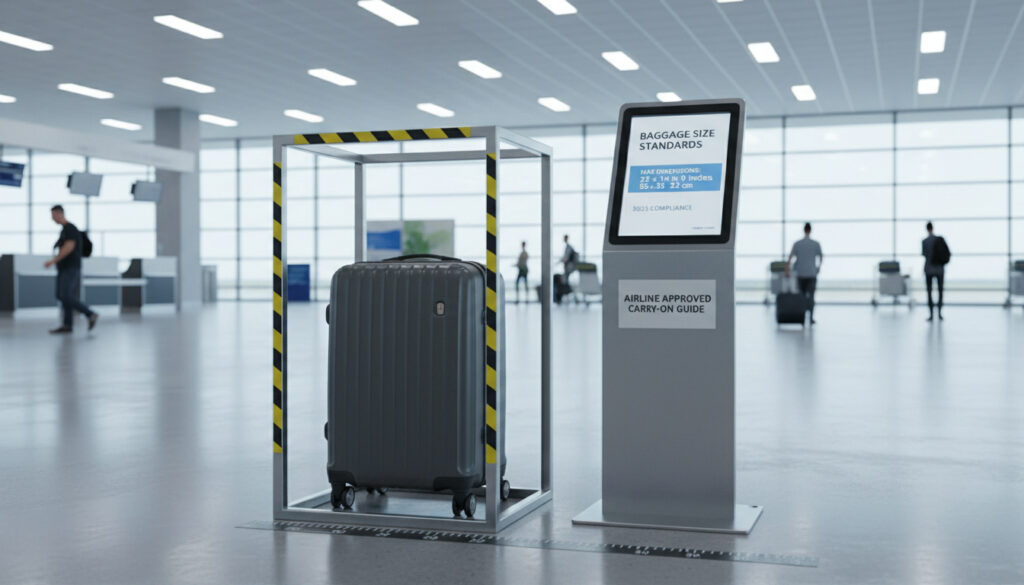
Hand Carry Luggage Size – 2025 Airline Standards Guide
Navigating hand carry luggage size limits remains one of the most persistent challenges for modern travelers. Despite decades of commercial aviation, no universal standard governs what passengers may bring into the cabin, creating a landscape of varying restrictions that differ not just between continents, but often between carriers serving the same routes.
The International Air Transport Association (IATA) offers reference guidelines, yet these remain non-binding recommendations rather than enforceable rules. According to IATA, maximum dimensions of 56 × 45 × 25 cm (22 × 18 × 10 inches) serve as optimal cabin baggage references, with weight limits typically starting at 5 kg (11 lb). Individual airlines retain final authority over specific dimensions, weights, and fees.
Understanding these parameters requires examining both international reference standards and specific carrier implementations. From the strict limits of European low-cost carriers to the relatively generous allowances of certain North American legacy airlines, the dimensions of permitted hand luggage reflect broader operational priorities including cabin safety, overhead bin capacity, and revenue optimization.
What Is the Standard Hand Carry Luggage Size?
56 × 45 × 25 cm
22 × 18 × 10 in
Non-binding guideline
55 × 40 × 20 cm
Ryanair/EasyJet standard
Paid carry-on
22 × 14 × 9 in
56 × 36 × 23 cm
Most common US standard
Starting at 5 kg
11 lb minimum
Varies by class/aircraft
- IATA guidelines suggest maximum dimensions of 56 × 45 × 25 cm including wheels and handles, though these serve as reference points rather than enforceable standards.
- Weight limits typically begin at 5 kg (11 lb) but vary significantly by airline, cabin class, and aircraft configuration.
- European budget carriers often enforce stricter limits than full-service international airlines.
- US domestic carriers generally permit larger dimensions than their European counterparts, with Southwest allowing 24 × 16 × 10 inches.
- Items exceeding published limits must be transported in the aircraft hold, often incurring additional fees.
- No strict 2025 enforcement of standardized sizing exists across the industry.
- Passengers must verify specific route requirements, as allowances may differ even within the same airline network.
| Airline Type | Max Dimensions (cm) | Weight Limit | Notes |
|---|---|---|---|
| IATA Reference | 56 × 45 × 25 | 5+ kg | Non-binding guideline only |
| Ryanair | 55 × 40 × 20 | Varies | Strict European budget standard |
| EasyJet | 55 × 40 × 20 | Varies | Matches Ryanair dimensions |
| American Airlines | 56 × 36 × 23 | Varies | 22 × 14 × 9 inches |
| Delta Air Lines | 56 × 36 × 23 | Varies | Max 45 linear inches |
| United Airlines | 56 × 36 × 23 | Varies | Includes wheels/handles |
| Southwest Airlines | 61 × 41 × 25 | Varies | 24 × 16 × 10 inches; most generous US |
| Frontier/Spirit | ~46 × 36 × 20 | Varies | Free personal item only (~18 × 14 × 8 in) |
How Does Hand Luggage Size Vary by Airline?
Airline-specific policies create significant variation in acceptable cabin baggage dimensions. Major carriers measure total exterior dimensions with no leeway for soft-sided compression, utilizing rigid sizers at boarding gates to verify compliance.
European Budget Operations
Ryanair and EasyJet both enforce dimensions of 55 × 40 × 20 cm for paid cabin bags. This sizing represents what industry observers note as the “stingiest” European standard, designed to fit restrictive overhead compartments on high-density short-haul aircraft. Both carriers typically require additional payment for carry-on privileges beyond the free personal item allowance.
United States Legacy Standards
Major American airlines including American, Delta, and United maintain consistent limits of 22 × 14 × 9 inches (56 × 36 × 23 cm). Southwest Airlines offers notably more generous parameters at 24 × 16 × 10 inches. Budget carriers like Frontier and Spirit restrict free allowances to personal items measuring approximately 18 × 14 × 8 inches, charging fees for larger carry-ons.
Travelers moving between regions should note that a bag compliant with US standards may exceed European budget limits. For those planning multi-destination itineraries, such as a journey covering Ho Chi Minh to Hanoi – Complete Travel Guide routes with onward connections to Europe, verifying each segment’s specific requirements prevents unexpected gate fees.
How Do You Measure Hand Luggage Size Correctly?
Accurate measurement determines whether luggage qualifies for cabin transport. Airlines calculate total exterior dimensions at the widest points, including all protrusions.
Measurement Protocol
Place the packed bag against a flat wall. Mark the furthest points of any wheels, telescoping handles, side pockets, and protective feet. Measure the distance between marks for height, width, and depth. Soft-sided bags receive no compression allowances; measurements reflect the fully packed state.
Wheels and Handles Inclusion
Wheels and handles definitively form part of the total measurement. According to IATA guidelines and major airline policies, a 22-inch tall suitcase with 2-inch wheels effectively becomes a 24-inch bag in regulatory terms. Airlines provide no tolerance for removing wheels or compressing handles during measurement.
Airlines utilize rigid metal sizers at departure gates. If the bag cannot slide fully into the sizer—wheels down, handles extended—it faces mandatory gate checking regardless of the tag or booking class.
The 55 × 40 × 20 Centimeter Standard
This specific dimension set has emerged as a potential emerging standard for European operations. While unconfirmed as a universal requirement in 2025, this sizing currently represents the safest bet for travelers seeking compatibility with strict budget airlines. Financial planning for such travel requires attention to currency exchange as well as baggage policies. Those transferring funds for international trips might consult 1000 MYR to SGD – Live Rate, Historical Trends and Best Transfer Tips for current conversion benchmarks.
What Happens If Your Hand Luggage Is Too Big?
Oversized bags face mandatory gate checking when they fail to fit airline sizers. Crews remove non-compliant luggage for placement in the cargo hold, frequently triggering additional fees. While specific penalty amounts vary by carrier and route, passengers typically encounter charges exceeding standard checked baggage rates due to last-minute handling requirements.
Recent discussions regarding European Parliament proposals on cabin baggage standardization have drawn criticism from aviation authorities. IATA opposes binding legislative mandates as regulatory overreach that could complicate operational flexibility. No confirmed industry-wide size reductions took effect in 2025.
Gate-checked bags risk damage to fragile contents and separation from passengers during connections. Security regulations regarding liquids remain distinct from size enforcement; the 3-1-1 rule applies regardless of bag dimensions.
How Have Hand Luggage Standards Evolved?
- Pre-2010s: Minimal standardization prevailed, with airlines setting independent limits based on specific aircraft types and cabin configurations.
- 2015: IATA published reference guidelines suggesting 56 × 45 × 25 cm as optimal cabin dimensions, establishing a non-binding industry reference point.
- 2016-2020: European budget carriers progressively reduced free allowances, introducing tiered paid carry-on systems to maximize ancillary revenue.
- 2023-2024: Discussions emerged regarding potential EU-wide standardization at 55 × 40 × 20 cm, though these remained speculative.
- Early 2025: Rumors of US/EU alignment at reduced dimensions proved unconfirmed; regulatory proposals faced industry opposition.
What Do We Know for Certain About Hand Luggage Sizes?
Established Information
- IATA recommends 56 × 45 × 25 cm as maximum reference dimensions
- Wheels and handles definitively count toward total size
- Ryanair and EasyJet enforce 55 × 40 × 20 cm for paid cabin bags
- Major US airlines maintain 22 × 14 × 9 inches as standard
- Oversized bags require gate checking with applicable fees
Remaining Uncertainties
- Potential 2025 standardization at 55 × 40 × 20 cm across jurisdictions
- Consistency of enforcement at boarding gates across all routes
- Future European Parliament regulatory mandates
- Weight limit standardization by aircraft type
Why Do Airlines Enforce Hand Luggage Size Limits?
Airlines restrict cabin baggage dimensions primarily to ensure aviation safety and operational efficiency. Overhead bins possess finite volumes; exceeding these limits risks injury during turbulence and impedes emergency evacuation protocols. Weight distribution also affects aircraft balance, particularly on smaller regional jets where load calculations influence fuel requirements.
Regional variations reflect differing aircraft fleets and competitive strategies. North American carriers often operate larger narrow-body aircraft on domestic routes, accommodating more generous stowage. European budget airlines maximize passenger density on short sectors, necessitating stricter limits to preserve bin space for revenue-generating cabin bags.
What Do Aviation Authorities Say About Carry-On Standards?
IATA provides general reference guidelines for carry-on baggage, recommending maximum dimensions of 56 × 45 × 25 cm, including wheels and handles. Weight limits typically start at 5 kg, but allowances vary by airline, cabin class, and aircraft type.
— International Air Transport Association
Airlines measure total exterior dimensions with no leeway for soft-sided compression. Items exceeding limits must go in the hold.
— IATA Passenger Baggage Guidelines
Key Takeaways on Hand Carry Luggage Sizes
No universal hand carry luggage size exists across the aviation industry. Travelers should verify specific airline requirements before departure, measuring bags at their maximum exterior points including wheels and handles. While IATA suggests 56 × 45 × 25 cm as a reference, European budget carriers typically enforce stricter 55 × 40 × 20 cm limits, and US majors generally accept 22 × 14 × 9 inches. Oversized bags face gate checking and fees, making pre-flight verification essential for avoiding disruption.
Frequently Asked Questions
Can you take a backpack as hand luggage?
Yes, backpacks qualify as hand luggage if they meet dimensional requirements. Most airlines accept backpacks as personal items if under 17 × 10 × 9 inches, or as full carry-ons if complying with 22 × 14 × 9 inch standards.
What are US airline carry-on sizes?
Major carriers including American, Delta, and United permit 22 × 14 × 9 inches (56 × 36 × 23 cm). Southwest allows larger dimensions at 24 × 16 × 10 inches. Budget carriers like Frontier and Spirit restrict free allowances to personal items around 18 × 14 × 8 inches.
What are standard personal item size limits?
Personal items must fit under seat dimensions, typically around 17 × 10 × 9 inches for US carriers. A universal safe size for European and Asian budget airlines measures approximately 40 × 25 × 20 cm.
Do hand luggage liquid rules affect size calculations?
Liquids restrictions operate independently of size limits. The TSA and EU enforce 3-1-1 rules: containers holding 3.4 ounces (100 ml) or less, placed in one quart-sized bag, removed during security screening but packed within standard hand luggage.
Is 55 × 40 × 20 cm acceptable on all airlines?
This size fits European budget carriers like Ryanair and EasyJet but may prove restrictive for US legacy carriers on international routes where stricter enforcement applies. Always verify specific route requirements.
More related posts
 Penang to Singapore Flight: Time, Airlines, and Cheap Tickets
 Sinners (2025 Film) Reviews – 97% Rotten Tomatoes Score
 Convert Photo to PDF: Free Online Converter & Guide
 OCBC Red Packet 2026: Release, Design, Locations & Reservations
 Najib Razak Verdict Reactions: 1MDB Scandal Conviction Analysis
 US to EU Shoe Size Conversion: Charts & Guide
 Ji De Chi Menu: Guide to Singapore’s Popular Dessert Spot